
Quick Summary
Question Type: Resonance stability comparison
Chapter: GOC – Resonance and Stability of Structures
Difficulty: ⭐⭐⭐ Medium
Time to Solve: 2-3 minutes
Key Formula: More stable resonance structures have complete octet, minimum charge separation, and negative charge on more electronegative atom
Correct Answer: (D)
Why: Option D is least stable because it places negative charge on carbon, which is less electronegative and stabilizes negative charge poorly.
The Question
JEE Main 2026 – GOC
From the following, the least stable structure is:
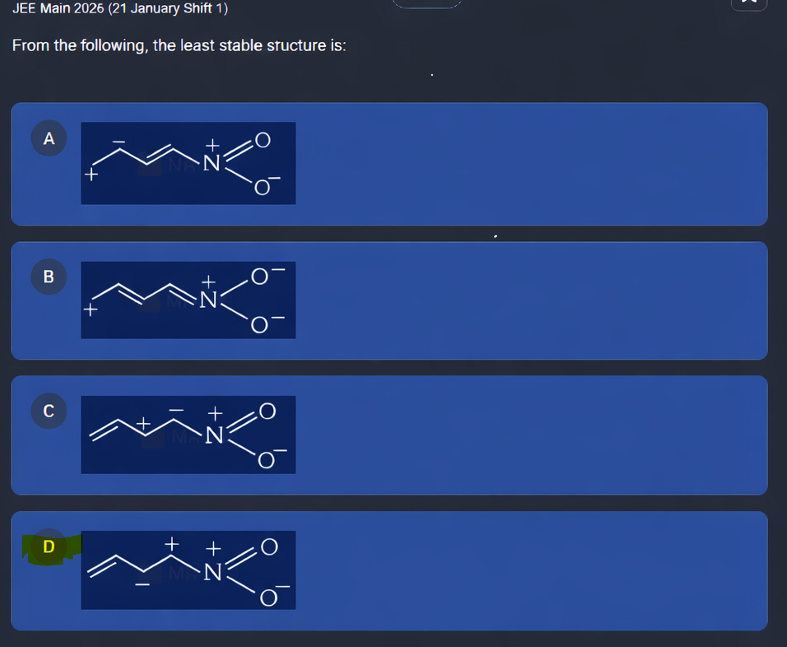
Options shown in the question image:
(A) Resonance structure A
(B) Resonance structure B
(C) Resonance structure C
(D) Resonance structure D
Quick Answer
Correct Option: (D)
Reasoning: The stability of resonance structures depends mainly on octet completion, minimum charge separation, and the position of charges. A negative charge is most stable on a more electronegative atom like oxygen. In option D, the negative charge is placed on carbon, which is less electronegative, so this structure is the least stable among the given options.
Video Solution
If you want the full explanation in a clear step-by-step teaching format, watch the video solution below:
Watch Full Video Solution on YouTube
Understanding the Concept
Why Resonance Structure Stability Changes
Not all resonance structures contribute equally to the resonance hybrid. Some are more stable and contribute more, while less stable structures contribute less. To compare them, we use standard stability rules from GOC.
Important Stability Rules
Where:
- Complete octet increases stability
- Less charge separation increases stability
- Negative charge is more stable on a more electronegative atom
- Positive charge is more stable on a less electronegative atom
The Key Principle
To compare resonance structures:
- Check whether octets are complete
- Check where positive and negative charges are located
- Prefer structures that place negative charge on oxygen, nitrogen, or other more electronegative atoms
Detailed Step-by-Step Solution
Step 1: Identify the Stability Criteria
- Octet completion is important
- Minimum charge separation gives higher stability
- Negative charge prefers more electronegative atoms
- Electronegativity order relevant here: O > N > C
Step 2: Analyze the Given Structures
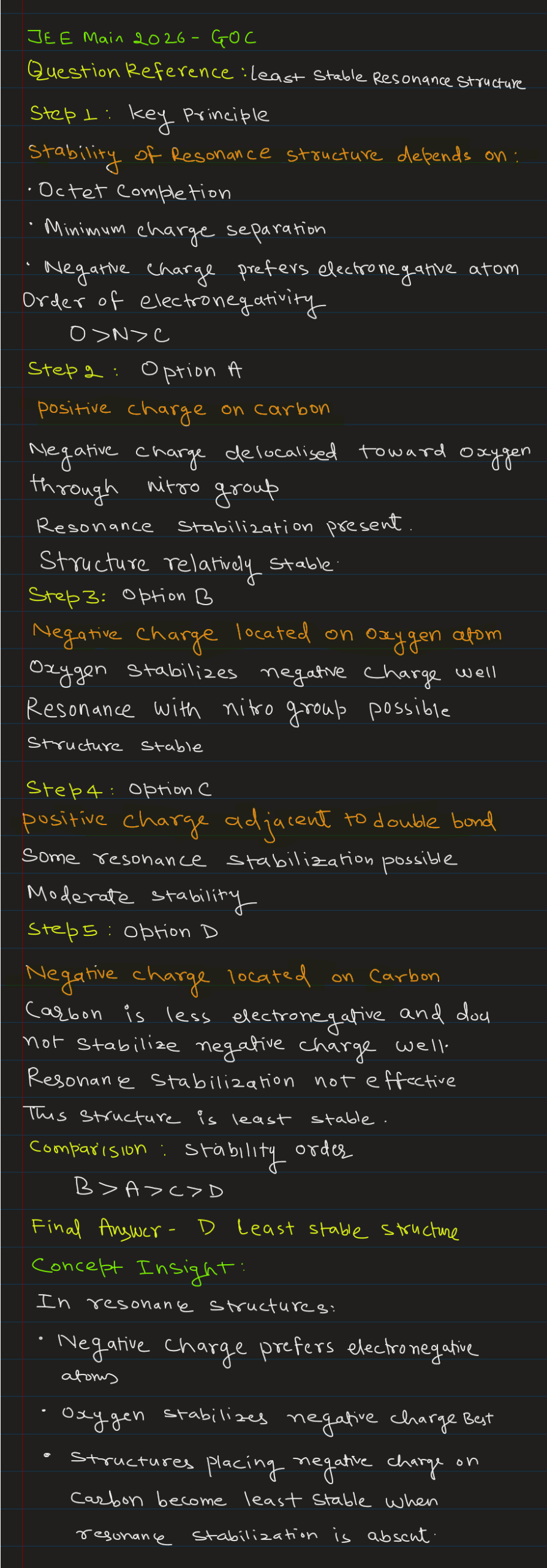
Option A:
- Positive charge is present on carbon
- Negative charge is effectively delocalized toward the nitro group
- Resonance stabilization is present, so this structure is relatively stable
Option B:
- Negative charge is located on oxygen atoms
- Oxygen stabilizes negative charge very well
- This makes option B the most stable or one of the most stable contributors
Option C:
- Positive charge is adjacent to a double bond
- Some resonance stabilization is still possible
- This gives moderate stability
Step 3: Examine Option D Carefully
Option D is problematic because:
- Negative charge is placed on carbon
- Carbon is less electronegative and cannot stabilize negative charge effectively
- This makes the resonance contributor significantly less stable
Step 4: Compare Overall Stability
Since oxygen stabilizes negative charge best and carbon stabilizes it poorly:
- Option B is highly stable
- Option A is also reasonably stabilized
- Option C has moderate stability
- Option D is the least stable
Therefore, the stability order is:
- B > A > C > D
Final Answer
Option (D) ✓
Option D is the least stable resonance structure because it places negative charge on carbon, which is less electronegative and does not stabilize negative charge effectively.
Essential Formulas for This Topic
Primary Stability Rules
- Octet Rule:
- Structures with complete octets are more stable
- Incomplete octet lowers stability
- Octet satisfaction is checked first in resonance comparison
- Charge Stability Rule:
- Negative charge is more stable on more electronegative atom
- Positive charge is more stable on less electronegative atom
- Oxygen stabilizes negative charge better than carbon
- Charge Separation Rule:
- Less charge separation means more stability
- More delocalization means more stability
- Major resonance contributors are lowest in energy
Important Constants
- Electronegativity trend used here: O > N > C
- Negative charge prefers oxygen over nitrogen over carbon
- Resonance structures do not exist separately; they contribute to the hybrid
- More stable contributor has greater contribution to the resonance hybrid
Common Mistakes to Avoid
❌ Mistake 1: Looking Only at Charge Count
Wrong Thinking: “All structures have charges, so they should have similar stability.”
Correct Approach: Stability does not depend only on the presence of charge. It depends on where the charge is located and whether the atom can stabilize it.
❌ Mistake 2: Ignoring Electronegativity
Wrong Approach: Not checking whether the negative charge is on oxygen, nitrogen, or carbon
Correct Approach: Always check the atom carrying the negative charge. A negative charge on oxygen is much more stable than a negative charge on carbon.
❌ Mistake 3: Forgetting Resonance Contribution Rules
Common Error:
- Assuming all resonance structures contribute equally
- Ignoring major and minor contributor logic
Correct Approach: More stable resonance forms contribute more; least stable forms contribute least.
❌ Mistake 4: Missing the Least Stable Structure
Wrong Thinking: “If a structure has resonance, it must be stable.”
Correct Understanding:
- Some structures are resonance contributors but weak contributors
- Charge on carbon often lowers stability if a better atom like oxygen could bear it
- Electronegativity strongly affects resonance stability
- The least stable contributor is the one with the poorest charge placement
Key Concept Summary
What You Must Remember
- Complete octet comes first: Structures with complete octets are preferred
- Negative charge prefers electronegative atom: Oxygen stabilizes it far better than carbon
- Less charge separation is better: Lower formal charge separation usually means higher stability
- All resonance forms are not equal: Some are major contributors, others are minor
- Carbon is poor at stabilizing negative charge: So such structures are often least stable
The Golden Rule for Resonance Stability
“Among resonance structures, the one with complete octet, minimum charge separation, and negative charge on the most electronegative atom is more stable.”
Frequently Asked Questions
Q1: How do we identify the least stable resonance structure?
A: Check octet completion, charge separation, and most importantly where the charges are located. A negative charge on a less electronegative atom like carbon usually reduces stability.
Q2: Why is oxygen better at holding negative charge than carbon?
A: Oxygen is more electronegative, so it attracts electron density more strongly and stabilizes negative charge better than carbon.
Q3: Do all resonance structures contribute equally to the hybrid?
A: No. More stable resonance structures contribute more, while less stable ones contribute less.
Q4: What is the most important rule in resonance stability questions?
A: First check octet completion, then check charge placement and electronegativity.
Q5: Why is option D least stable here?
A: Because it places the negative charge on carbon, where stabilization is poor compared to oxygen or nitrogen-containing structures.
Prerequisites to Solve This Question
Before attempting this problem, you should understand:
- Resonance concept: Different contributors and resonance hybrid idea
- Formal charge basics: How positive and negative charges appear in structures
- Electronegativity: Why some atoms stabilize charge better than others
- Octet rule: Why complete valence shell increases stability
- GOC stability logic: Comparing structures based on standard organic chemistry rules
After Solving This, You Can:
✅ Compare resonance structure stability confidently
✅ Identify major and minor resonance contributors
✅ Use electronegativity in stability-based questions
✅ Solve JEE Main GOC questions on resonance more accurately
✅ Avoid common mistakes in charge-placement questions
✅ Understand why some contributors are least stable even if they are valid resonance forms
Study Tips for This Topic
For JEE Main:
- Memorize the stability rules: Octet, electronegativity, and charge separation
- Practice charge-placement questions: Especially where oxygen, nitrogen, and carbon compete
- Learn to rank contributors quickly: This saves time in MCQs
- Watch for least stable wording: Many students accidentally mark the most stable one
Common JEE Variants:
- Most stable resonance structure
- Least stable resonance structure
- Major contributor to resonance hybrid
- Charge distribution and stability comparison in GOC
Difficulty Rating & Exam Frequency
Difficulty Level: ⭐⭐⭐ (3/5) – Medium
JEE Main Frequency: High – Resonance stability is a common GOC concept
JEE Advanced Frequency: Medium – Often combined with formal charge and aromaticity ideas
Topic Importance: Very High – Fundamental to stability and reactivity in organic chemistry
Written by Nishant Kumar
Chemistry Educator with 10+ Years of Experience Teaching JEE Aspirants
Founder – PadhoLikhoJEE
Last Updated: March 2026
Question Source: JEE Main 2026 PYQ
Topic: GOC – Resonance and Stability of Structures