
First Order Decomposition Time Ratio – Chemical Kinetics JEE Main 2026 PYQ
Quick Summary
Question Type: First order reaction time calculation
Chapter: Chemical Kinetics – First Order Reactions
Difficulty: ⭐⭐ Easy
Time to Solve: 2-3 minutes
Key Formula: t = (2.303 / k) log([A]₀ / [A])
Correct Answer: (B) 9
Why: For a first order reaction, time is proportional to log([A]₀ / [A]). Using [A] = [A]₀/8 and [A] = [A]₀/10 gives t₁/₈ / t₁/₁₀ = 0.9, so the required value is 9.
The Question
JEE Main 2026 – Chemical Kinetics
An organic compound undergoes first order decomposition. The time taken for decomposition to (1/8)th and (1/10)th of its initial concentration are t₁/₈ and t₁/₁₀ respectively.
What is the value of (t₁/₈ / t₁/₁₀) × 10 ?
Given: log 2 = 0.3
(A) 30
(B) 9
(C) 3
(D) 0.9
Quick Answer
Correct Option: (B) 9
Reasoning: For a first order reaction,
- t₁/₈ = (2.303 / k) log 8 = (2.303 / k) × 3 log 2 = (2.303 / k) × 0.9
- t₁/₁₀ = (2.303 / k) log 10 = (2.303 / k) × 1
- So t₁/₈ / t₁/₁₀ = 0.9
- Therefore, (t₁/₈ / t₁/₁₀) × 10 = 9
Video Solution
If you want the full explanation in a clear step-by-step teaching format, watch the video solution below:
Watch Full Video Solution on YouTube
Understanding the Concept
Why First Order Time Depends on Logarithm
In a first order reaction, the time taken to reach any particular concentration depends on the logarithm of the ratio of initial concentration to final concentration. This makes such questions very fast if you know the standard formula.
t = (2.303 / k) log([A]₀ / [A])
Where:
- t = time taken
- k = first order rate constant
- [A]₀ = initial concentration
- [A] = concentration after time t
The Key Principle
To solve such questions:
- Use the first order integrated rate equation
- Substitute the final concentration in terms of initial concentration
- Take the required ratio so that common terms cancel
Detailed Step-by-Step Solution
Step 1: Write the First Order Formula
- For first order reactions: t = (2.303 / k) log([A]₀ / [A])
- This formula gives time to reach any concentration from the initial value
- We will use it for t₁/₈ and t₁/₁₀ separately
Step 2: Calculate t₁/₈
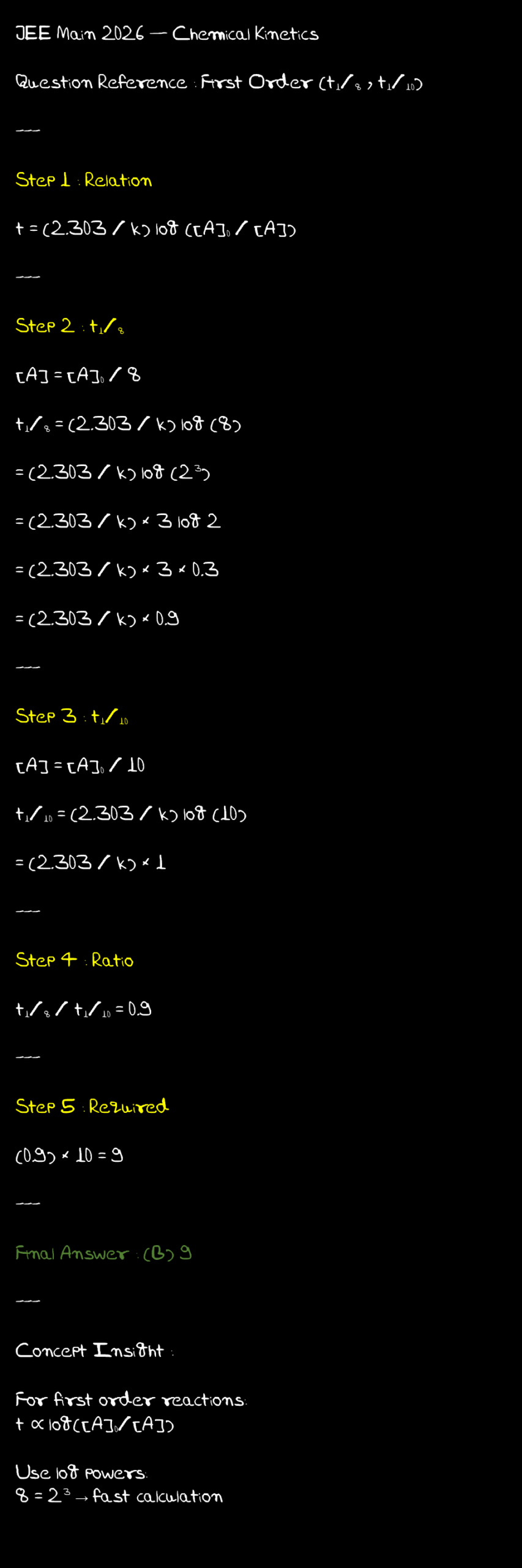
- At t₁/₈, the concentration becomes [A] = [A]₀ / 8
- So t₁/₈ = (2.303 / k) log([A]₀ / ([A]₀/8))
- t₁/₈ = (2.303 / k) log 8
- Since 8 = 2³, log 8 = 3 log 2 = 3 × 0.3 = 0.9
- Therefore, t₁/₈ = (2.303 / k) × 0.9
Step 3: Calculate t₁/₁₀
- At t₁/₁₀, the concentration becomes [A] = [A]₀ / 10
- So t₁/₁₀ = (2.303 / k) log([A]₀ / ([A]₀/10))
- t₁/₁₀ = (2.303 / k) log 10
- Since log 10 = 1, t₁/₁₀ = (2.303 / k)
Step 4: Take the Required Ratio
- t₁/₈ / t₁/₁₀ = [(2.303 / k) × 0.9] / (2.303 / k)
- t₁/₈ / t₁/₁₀ = 0.9
Step 5: Final Calculation
- (t₁/₈ / t₁/₁₀) × 10 = 0.9 × 10
- = 9
Final Answer
Option (B): 9 ✓
For a first order decomposition reaction, the required value of (t₁/₈ / t₁/₁₀) × 10 is 9.
Essential Formulas for This Topic
Primary Equations
- First Order Integrated Rate Law:
- t = (2.303 / k) log([A]₀ / [A])
- Used to find time at any concentration
- Valid for first order reactions
- Logarithm Shortcuts:
- log 10 = 1
- log 8 = log(2³) = 3 log 2
- If log 2 = 0.3, then log 8 = 0.9
- Ratio Logic:
- In ratios, common factors cancel
- (2.303 / k) cancels in t₁/₈ / t₁/₁₀
- This makes the calculation very fast
Important Constants
- Given in question: log 2 = 0.3
- Standard value: log 10 = 1
- For first order reactions, time depends logarithmically on concentration ratio
- Rate constant k remains constant for a first order process at fixed temperature
Common Mistakes to Avoid
❌ Mistake 1: Using the Wrong Rate Law
Wrong Thinking: “Use zero order or second order formula directly.”
Correct Approach: The question clearly says first order decomposition, so always use the first order integrated rate law.
❌ Mistake 2: Misreading (1/8)th and (1/10)th of Initial Concentration
Wrong Approach: Taking [A] = 1/8 or 1/10 directly without relating it to [A]₀
Correct Approach: Write [A] = [A]₀/8 and [A] = [A]₀/10 before substituting into the formula.
❌ Mistake 3: Incorrect Log Calculation
Common Error:
- Taking log 8 = 8 log 2
- Forgetting that 8 = 2³
Correct Approach: Use log 8 = log(2³) = 3 log 2 = 0.9.
❌ Mistake 4: Forgetting the Final Multiplication by 10
Wrong Thinking: “Answer is 0.9.”
Correct Understanding:
- First calculate t₁/₈ / t₁/₁₀ = 0.9
- Then multiply by 10 as asked in the question
- Final answer becomes 9
Key Concept Summary
What You Must Remember
- First order time formula: t = (2.303 / k) log([A]₀ / [A])
- Use concentration ratios carefully: [A] = [A]₀/8 and [A] = [A]₀/10 here
- Log shortcuts save time: log 8 = 3 log 2 = 0.9
- Take ratios smartly: Common factors cancel
- Read the final expression carefully: Multiply by 10 at the end
The Golden Rule for First Order Time Questions
“Write the first order rate law first, substitute concentration ratios correctly, and simplify using logarithm rules.”
Frequently Asked Questions
Q1: Why do we use the first order integrated rate law here?
A: Because the question clearly states that the compound undergoes first order decomposition.
Q2: How do we write concentration at t₁/₈?
A: At t₁/₈, the concentration becomes [A] = [A]₀/8.
Q3: Why does k cancel in the ratio?
A: Both t₁/₈ and t₁/₁₀ contain the common factor (2.303 / k), so it cancels when we divide them.
Q4: Why is log 8 equal to 0.9?
A: Since 8 = 2³, log 8 = 3 log 2 = 3 × 0.3 = 0.9.
Q5: What is the final answer to (t₁/₈ / t₁/₁₀) × 10?
A: The final answer is 9.
Prerequisites to Solve This Question
Before attempting this problem, you should understand:
- First order reactions: Integrated rate law and its use
- Logarithms: Basic log properties like log aⁿ = n log a
- Concentration ratios: Translating fractions of initial concentration correctly
- Algebraic simplification: Cancelling common factors in ratios
- JEE MCQ reading: Carefully checking the exact final expression asked
After Solving This, You Can:
✅ Apply the first order rate law confidently
✅ Solve concentration-time ratio questions quickly
✅ Use logarithm shortcuts in Chemical Kinetics
✅ Avoid common mistakes in first order reaction numericals
✅ Solve JEE Main Chemical Kinetics PYQs faster
✅ Handle similar decomposition problems with ease
Study Tips for This Topic
For JEE Main:
- Memorize the first order formula: It appears very frequently
- Practice log-based simplifications: These save crucial time in numericals
- Use ratio method: It often cancels constants and makes the question easier
- Read the final asked quantity carefully: Do not stop one step early
Common JEE Variants:
- Time to reach a fraction of initial concentration
- Half-life based first order questions
- Comparison of times for different concentration changes
- Logarithm-based Chemical Kinetics numericals
Difficulty Rating & Exam Frequency
Difficulty Level: ⭐⭐ (2/5) – Easy
JEE Main Frequency: High – First order kinetics questions are common
JEE Advanced Frequency: Medium – Usually combined with deeper kinetics concepts
Topic Importance: Very High – First order reactions are a core part of Chemical Kinetics
Written by Nishant Kumar
Chemistry Educator with 10+ Years of Experience Teaching JEE Aspirants
Founder – PadhoLikhoJEE
Last Updated: March 2026
Question Source: JEE Main 2026 PYQ
Topic: Chemical Kinetics – First Order Reactions