
Weak Base Buffer Volume Calculation – Ionic Equilibrium JEE Main 2026 PYQ
Quick Summary
Question Type: Buffer solution and Henderson equation calculation
Chapter: Ionic Equilibrium – Buffer Solution
Difficulty: ⭐⭐⭐ Medium
Time to Solve: 3-5 minutes
Key Formula: pOH = pKb + log([Salt]/[Base])
Correct Answer: (B) x = 14.3, y = 85.7
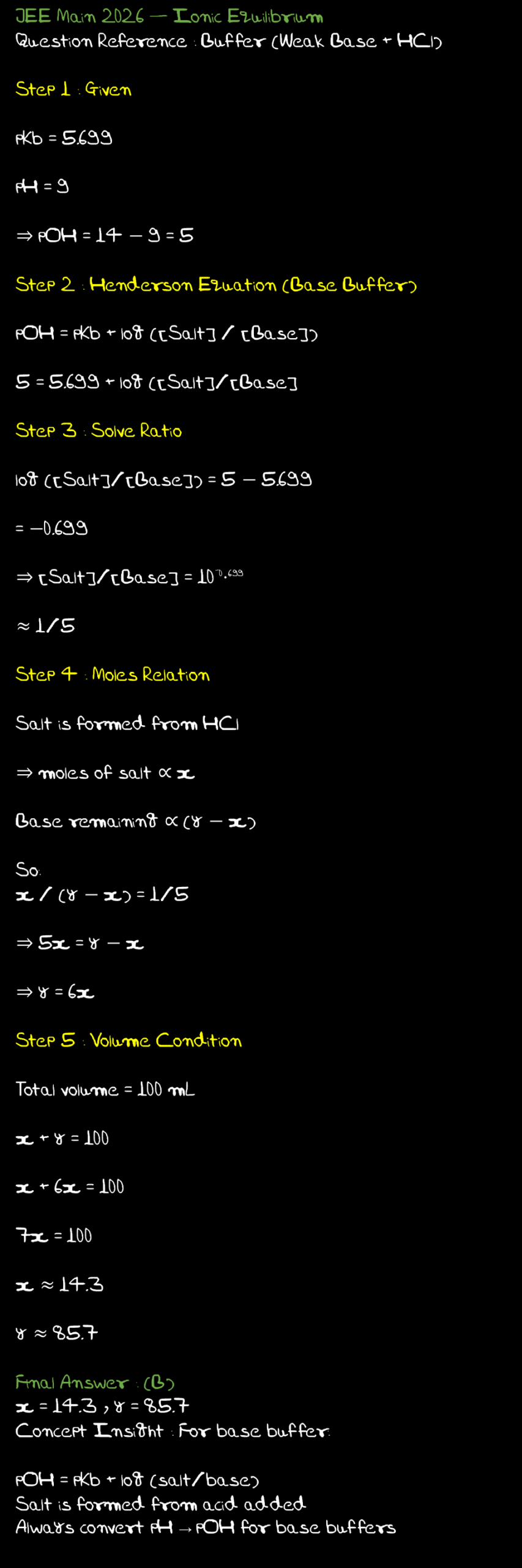
Why: Since pH = 9, pOH = 5. Using pOH = pKb + log([Salt]/[Base]) gives [Salt]/[Base] = 1/5. Then x/(y – x) = 1/5 and x + y = 100, so x = 14.3 mL and y = 85.7 mL.
The Question
JEE Main 2026 – Ionic Equilibrium
Consider a weak base B of pKb = 5.699. x mL of 0.02 M HCl and y mL of 0.02 M weak base B are mixed to make 100 mL of a buffer of pH 9 at 25°C. The values of x and y respectively are:
Given: log 2 = 0.3010, log 3 = 0.4771, log 5 = 0.699
(A) x = 42.7, y = 57.3
(B) x = 14.3, y = 85.7
(C) x = 85.7, y = 14.3
(D) x = 11.1, y = 88.9
Quick Answer
Correct Option: (B) x = 14.3, y = 85.7
Reasoning: This is a basic buffer formed by mixing a weak base with a strong acid. Since pH = 9, we first calculate pOH = 14 – 9 = 5. Then:
- pOH = pKb + log([Salt]/[Base])
- 5 = 5.699 + log([Salt]/[Base])
- log([Salt]/[Base]) = -0.699
- [Salt]/[Base] = 1/5
Now salt formed is proportional to x, and base remaining is proportional to y – x.
- x / (y – x) = 1/5
- y = 6x
- x + y = 100
- 7x = 100
- x = 14.3 mL, y = 85.7 mL
Video Solution
If you want the full explanation in a clear step-by-step teaching format, watch the video solution below:
Watch Full Video Solution on YouTube
Understanding the Concept
Why This Is a Basic Buffer Problem
When a weak base is partially neutralized by a strong acid, a basic buffer is formed. The final solution contains:
- unreacted weak base
- its salt formed by reaction with strong acid
For such a buffer, we use the Henderson equation:
pOH = pKb + log([Salt]/[Base])
So the whole problem reduces to finding the ratio of salt to base and then relating that ratio to the given volumes.
The Key Principle
- Convert pH into pOH
- Use the Henderson equation for a basic buffer
- Express salt and base in terms of x and y
- Use total volume = 100 mL
Detailed Step-by-Step Solution
Step 1: Calculate pOH
- Given pH = 9
- So pOH = 14 – 9 = 5
Step 2: Apply Henderson Equation for Basic Buffer
- Use: pOH = pKb + log([Salt]/[Base])
- 5 = 5.699 + log([Salt]/[Base])
- log([Salt]/[Base]) = -0.699
Step 3: Find the Ratio of Salt to Base
- [Salt]/[Base] = 10-0.699
- Since log 5 = 0.699, 10-0.699 = 1/5
- Therefore, [Salt]/[Base] = 1/5
Step 4: Relate the Ratio to x and y
- Salt is formed from HCl added, so salt ∝ x
- Weak base remaining after neutralization ∝ y – x
- So x / (y – x) = 1/5
Solving:
- 5x = y – x
- y = 6x
Step 5: Use Total Volume Condition
- x + y = 100
- x + 6x = 100
- 7x = 100
- x = 14.3 mL
- y = 85.7 mL
Final Answer
Option (B): x = 14.3, y = 85.7 ✓
The correct values are x = 14.3 mL and y = 85.7 mL.
Essential Formulas for This Topic
Primary Equations
- Basic Buffer Formula:
- pOH = pKb + log([Salt]/[Base])
- Used for weak base + strong acid buffer
- Always use pOH, not pH directly
- pH-pOH Relation:
- pH + pOH = 14
- At 25°C, pOH = 14 – pH
- Here pOH = 5
- Neutralization Logic:
- Salt formed = moles of HCl added
- Base remaining = initial base – consumed base
- These values are used in the buffer ratio
Important Constants
- Given: log 5 = 0.699
- At 25°C, pH + pOH = 14
- A buffer requires weak base and its salt together
- Strong acid partially neutralizes the weak base to form the buffer
Common Mistakes to Avoid
❌ Mistake 1: Using pH Directly
Wrong Thinking: “Put pH = 9 directly into the base buffer formula.”
Correct Approach: For a basic buffer, convert pH to pOH first. Here pOH = 5.
❌ Mistake 2: Reversing the Ratio
Wrong Approach: Using [Base]/[Salt] instead of [Salt]/[Base]
Correct Approach: The correct relation is pOH = pKb + log([Salt]/[Base]).
❌ Mistake 3: Taking y as Base Remaining
Common Error:
- Writing x / y = 1/5
- Ignoring that some base reacts with HCl
Correct Approach: Base remaining is y – x, not y.
❌ Mistake 4: Forgetting x + y = 100
Wrong Thinking: “After finding y = 6x, the problem is finished.”
Correct Understanding:
- The final mixture volume is 100 mL
- So x + y = 100
- This is required to get the actual numerical values
Key Concept Summary
What You Must Remember
- Weak base + strong acid gives a basic buffer: Use pOH, not pH directly
- Henderson equation is essential: pOH = pKb + log([Salt]/[Base])
- Salt comes from acid added: Base remaining is after neutralization
- Use the ratio carefully: x / (y – x) = salt/base
- Apply the total volume condition: x + y = 100
The Golden Rule for Basic Buffer Questions
“Convert pH to pOH first, then use the salt/base ratio after neutralization.”
Frequently Asked Questions
Q1: Why do we use pOH here instead of pH?
A: Because the buffer is made from a weak base and its salt, so the Henderson equation is written in terms of pOH and pKb.
Q2: Why is salt proportional to x?
A: Because the strong acid HCl forms the salt by reacting with the weak base, so its amount depends on x.
Q3: Why is the remaining base equal to y – x?
A: Because the amount of base consumed is equal to the amount of HCl added, so unreacted base is y – x.
Q4: How do we convert -0.699 into 1/5?
A: Since log 5 = 0.699, 10-0.699 = 1/5.
Q5: What are the final values of x and y?
A: x = 14.3 mL and y = 85.7 mL.
Prerequisites to Solve This Question
Before attempting this problem, you should understand:
- Buffer solutions: Acidic and basic buffer formation
- Henderson equation: For weak acid and weak base buffers
- Neutralization concept: Mole relation between acid and base
- pH and pOH conversion: At 25°C
- Basic logarithms: Especially powers and standard log values
After Solving This, You Can:
✅ Solve weak base buffer numerical questions confidently
✅ Use Henderson equation in JEE Main equilibrium problems
✅ Convert pH to pOH correctly for basic buffers
✅ Relate acid-base reaction moles to buffer composition
✅ Avoid common mistakes in salt/base ratio questions
✅ Handle similar Ionic Equilibrium PYQs faster
Study Tips for This Topic
For JEE Main:
- Memorize Henderson equations: For both acidic and basic buffers
- Identify the buffer type first: Weak acid buffer or weak base buffer
- Track neutralization carefully: Always see how much weak base remains
- Use log values smartly: They are often given to simplify the calculation
Common JEE Variants:
- Find pH of a buffer
- Find salt/base ratio
- Find volumes required to prepare a buffer
- Buffer calculation after partial neutralization
Difficulty Rating & Exam Frequency
Difficulty Level: ⭐⭐⭐ (3/5) – Medium
JEE Main Frequency: High – Buffer solution questions are common in Ionic Equilibrium
JEE Advanced Frequency: Medium – Often combined with salt hydrolysis and equilibrium concepts
Topic Importance: Very High – Buffer concept is a core part of Ionic Equilibrium
Written by Nishant Kumar
Chemistry Educator with 10+ Years of Experience Teaching JEE Aspirants
Founder – PadhoLikhoJEE
Last Updated: March 2026
Question Source: JEE Main 2026 PYQ
Topic: Ionic Equilibrium – Buffer Solution