
Thermodynamics Free Energy Equilibrium Question JEE Main 2026
Quick Summary
Question Type: Thermodynamics and equilibrium constant calculation
Chapter: Thermodynamics – Gibbs Free Energy and Equilibrium
Difficulty: ⭐⭐⭐ Medium
Time to Solve: 3-6 minutes
Key Formula: ΔG° = ΔH° – TΔS° = -2.303RT log K
Correct Answer: 70
Why: First calculate ΔG° from the given equilibrium constant, then use ΔG° = ΔH° – TΔS° for the reaction A₂(g) + B₂(g) ⇌ 2AB(g). Solving the resulting equation gives x = 70 kJ mol⁻¹.
The Question
JEE Main 2026 (21 January Morning Shift) – Thermodynamics
Use the following data:
| Substance | ΔfH°(500 K) / kJ mol-1 | S°(500 K) / J K-1 mol-1 |
|---|---|---|
| AB(g) | 32 | 222 |
| A2(g) | 6 | 146 |
| B2(g) | x | 280 |
One mole each of A2(g) and B2(g) are taken in a 1 L closed flask and allowed to establish the equilibrium at 500 K.
A2(g) + B2(g) ⇌ 2AB(g)
The value of x (in kJ mol-1) is ________. (Nearest integer)
Given: log K = 2.2, R = 8.3 J K-1 mol-1
Quick Answer
Correct Answer: 70
Reasoning: For the reaction:
A2(g) + B2(g) ⇌ 2AB(g)
- Use ΔG° = -2.303RT log K
- Use ΔG° = ΔH° – TΔS°
- Find ΔH° and ΔS° of reaction from formation enthalpy and entropy data
- Then solve for x
Final calculation gives:
- x = 70 kJ mol-1
Video Solution
If you want the full explanation in a clear step-by-step teaching format, watch the video solution below:
Watch Full Video Solution on YouTube
Understanding the Concept
Why This Is a Gibbs Free Energy Problem
This question connects equilibrium constant with thermodynamics. At constant temperature, the standard Gibbs free energy change of a reaction is related to equilibrium constant by:
ΔG° = -2.303RT log K
At the same time, Gibbs free energy is also related to enthalpy and entropy:
ΔG° = ΔH° – TΔS°
So this question becomes a bridge between equilibrium and thermodynamics.
The Key Principle
- Find ΔG° from the given K value
- Calculate ΔH° of reaction from formation enthalpies
- Calculate ΔS° of reaction from standard entropies
- Use ΔG° = ΔH° – TΔS° to solve for x
Detailed Step-by-Step Solution
Step 1: Calculate ΔG° from Equilibrium Constant
- Given: log K = 2.2
- Use: ΔG° = -2.303RT log K
- ΔG° = -2.303 × 8.3 × 500 × 2.2
- ΔG° ≈ -21020 J mol-1
- ΔG° ≈ -21.0 kJ mol-1
Step 2: Calculate ΔS° of Reaction
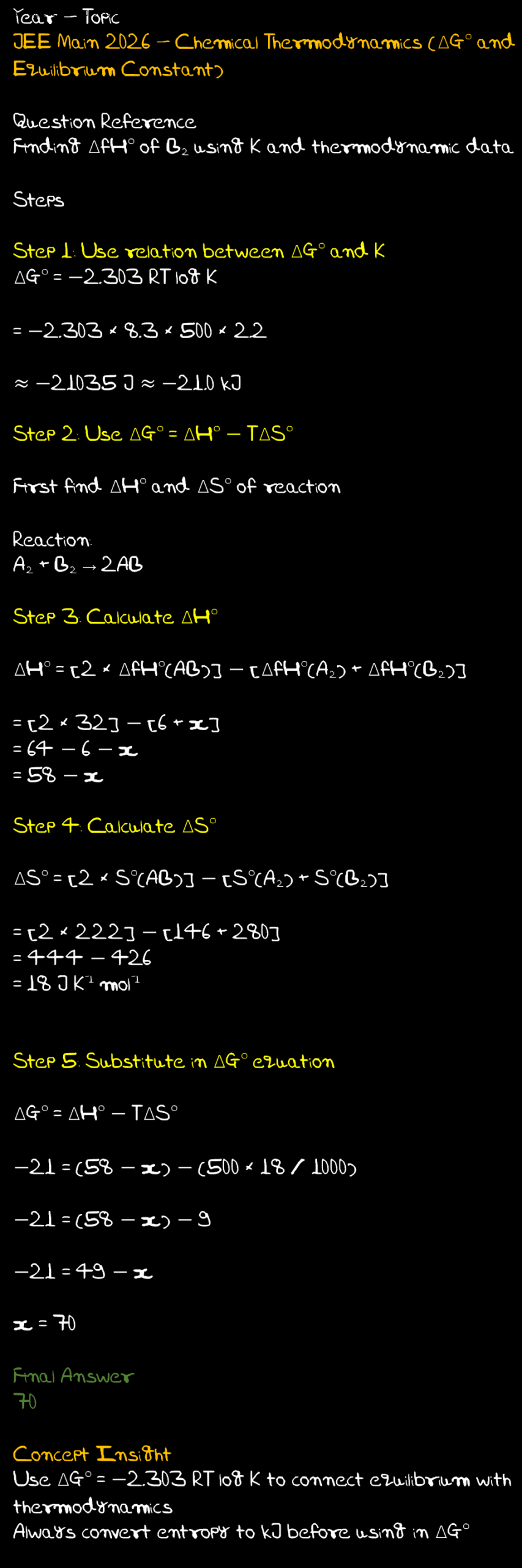
For the reaction:
A2(g) + B2(g) ⇌ 2AB(g)
- ΔS° = 2S°(AB) – [S°(A2) + S°(B2)]
- ΔS° = 2(222) – (146 + 280)
- ΔS° = 444 – 426
- ΔS° = 18 J K-1 mol-1
Step 3: Calculate ΔH° of Reaction
- ΔH° = 2ΔfH°(AB) – [ΔfH°(A2) + ΔfH°(B2)]
- ΔH° = 2(32) – (6 + x)
- ΔH° = 64 – 6 – x
- ΔH° = 58 – x kJ mol-1
Step 4: Apply ΔG° = ΔH° – TΔS°
- ΔG° = -21.0 kJ mol-1
- ΔH° = 58 – x
- TΔS° = 500 × 18 J = 9000 J = 9 kJ
So:
- -21 = (58 – x) – 9
- -21 = 49 – x
- x = 70
Step 5: Final Answer
- The value of x = 70 kJ mol-1
Final Answer
x = 70 ✓
The nearest integer value of x is 70 kJ mol-1.
Essential Formulas for This Topic
Primary Equations
- Gibbs Free Energy and Equilibrium:
- ΔG° = -2.303RT log K
- Connects equilibrium constant with spontaneity
- Valid at the given temperature
- Thermodynamic Relation:
- ΔG° = ΔH° – TΔS°
- Links free energy with enthalpy and entropy
- Useful for solving unknown thermodynamic quantities
- Reaction Property Formulae:
- ΔH° = ΣΔfH°(products) – ΣΔfH°(reactants)
- ΔS° = ΣS°(products) – ΣS°(reactants)
- Apply stoichiometric coefficients carefully
Important Constants
- Given: log K = 2.2
- Given: R = 8.3 J K-1 mol-1
- Given temperature: 500 K
- Remember to convert J to kJ when needed
Common Mistakes to Avoid
❌ Mistake 1: Wrong Sign in ΔG° = -2.303RT log K
Wrong Thinking: “Since log K is positive, ΔG° must also be positive.”
Correct Approach: The formula has a negative sign. So positive log K gives negative ΔG°.
❌ Mistake 2: Forgetting Stoichiometric Coefficient 2 for AB
Wrong Approach: Taking ΔH° or ΔS° using only one mole of AB
Correct Approach: The reaction forms 2AB, so multiply both formation enthalpy and entropy of AB by 2.
❌ Mistake 3: Unit Conversion Error in TΔS°
Common Error:
- Using ΔS° in J and ΔH° in kJ directly
- Not converting 9000 J to 9 kJ
Correct Approach: Keep all terms in the same unit before substituting in ΔG° = ΔH° – TΔS°.
❌ Mistake 4: Using Reaction Enthalpy Formula Incorrectly
Wrong Thinking: “Add x instead of subtracting it.”
Correct Understanding:
- ΔH° = products – reactants
- So ΔH° = 2(32) – (6 + x)
- That gives 58 – x
- Then solve with the free energy equation
Key Concept Summary
What You Must Remember
- Equilibrium constant gives ΔG°: Use ΔG° = -2.303RT log K
- Thermodynamic quantities are linked: Use ΔG° = ΔH° – TΔS°
- Formation data must be used carefully: Products minus reactants
- Always maintain unit consistency: Convert J into kJ when needed
- Stoichiometric coefficients matter: 2AB means multiply by 2
The Golden Rule for Thermodynamics + Equilibrium Questions
“Find ΔG° from K first, then connect it to ΔH° and ΔS° using the Gibbs equation.”
Frequently Asked Questions
Q1: Why is ΔG° negative here?
A: Because log K is positive and the relation ΔG° = -2.303RT log K has a negative sign.
Q2: Why do we multiply AB values by 2?
A: Because the balanced equation forms 2 moles of AB.
Q3: How is ΔS° calculated here?
A: ΔS° = 2(222) – (146 + 280) = 18 J K-1 mol-1.
Q4: Why is TΔS° equal to 9 kJ?
A: TΔS° = 500 × 18 = 9000 J = 9 kJ.
Q5: What is the final value of x?
A: The final value of x is 70 kJ mol-1.
Prerequisites to Solve This Question
Before attempting this problem, you should understand:
- Gibbs free energy: Relation with spontaneity and equilibrium
- Equilibrium constant: Meaning of K and log K
- Reaction enthalpy and entropy: Products minus reactants method
- Unit conversion: J and kJ consistency
- Balanced chemical equations: Correct use of coefficients
After Solving This, You Can:
✅ Relate equilibrium constant to Gibbs free energy
✅ Use thermodynamic data to solve unknown quantities
✅ Calculate reaction entropy and enthalpy correctly
✅ Handle mixed thermodynamics-equilibrium questions confidently
✅ Avoid unit conversion mistakes in numerical problems
✅ Solve JEE Main Thermodynamics PYQs faster
Study Tips for This Topic
For JEE Main:
- Memorize both Gibbs relations: They are often used together
- Check units carefully: This is where most mistakes happen
- Write reaction property formulae clearly: Products minus reactants
- Practice mixed-concept questions: JEE often combines equilibrium with thermodynamics
Common JEE Variants:
- Find ΔG° from equilibrium constant
- Find unknown ΔH° or ΔS°
- Use formation enthalpy data in equilibrium problems
- Thermodynamics and equilibrium combined numericals
Difficulty Rating & Exam Frequency
Difficulty Level: ⭐⭐⭐ (3/5) – Medium
JEE Main Frequency: Medium – Mixed thermodynamics-equilibrium questions appear regularly
JEE Advanced Frequency: High – Such concept-linking questions are very common
Topic Importance: Very High – Gibbs free energy and equilibrium are core thermodynamic ideas
Written by Nishant Kumar
Chemistry Educator with 10+ Years of Experience Teaching JEE Aspirants
Founder – PadhoLikhoJEE
Last Updated: March 2026
Question Source: JEE Main 2026 PYQ
Topic: Thermodynamics – Gibbs Free Energy and Equilibrium