
Salt Analysis Group Analysis Question JEE Main 2026
Quick Summary
Question Type: Qualitative analysis and cation group separation
Chapter: Salt Analysis – Group Analysis of Cations
Difficulty: ⭐⭐ Easy
Time to Solve: 2-3 minutes
Key Formula: Group V cations Ba²⁺ and Ca²⁺ are precipitated as carbonates
Correct Answer: (D) carbonate & carbonate
Why: In classical group analysis, Ba²⁺ and Ca²⁺ belong to the same cation group and are precipitated as their respective carbonates.
The Question
JEE Main 2026 (24 January Evening Shift) – Salt Analysis
In the Group analysis of cations, Ba²⁺ and Ca²⁺ are precipitated respectively as
(A) sulphide & sulphide
(B) hydroxide & carbonate
(C) chromate & sulphide
(D) carbonate & carbonate
Quick Answer
Correct Option: (D) carbonate & carbonate
Reasoning: In qualitative inorganic analysis, barium and calcium are Group V cations. They are precipitated in the presence of ammonium carbonate as their corresponding carbonates.
- Ba²⁺ → BaCO₃
- Ca²⁺ → CaCO₃
Therefore, both are precipitated as carbonate.
Video Solution
If you want the full explanation in a clear step-by-step teaching format, watch the video solution below:
Watch Full Video Solution on YouTube
Understanding the Concept
Why Group Analysis Uses Selective Precipitation
In salt analysis, cations are separated into groups based on their different solubility products. Specific group reagents are used so that only a certain set of cations precipitates at a time.
Barium and calcium belong to the carbonate precipitation group in classical qualitative analysis.
Group V cations are precipitated as carbonates
That is why both Ba²⁺ and Ca²⁺ are obtained as carbonate precipitates during group analysis.
The Key Principle
- Identify the cation group
- Recall the group reagent
- Recall the precipitated form of the ion
Detailed Step-by-Step Solution
Step 1: Identify the Relevant Cations
- Ba²⁺ = barium ion
- Ca²⁺ = calcium ion
- Both are alkaline earth metal cations considered in the same group analysis step
Step 2: Recall the Group Reagent
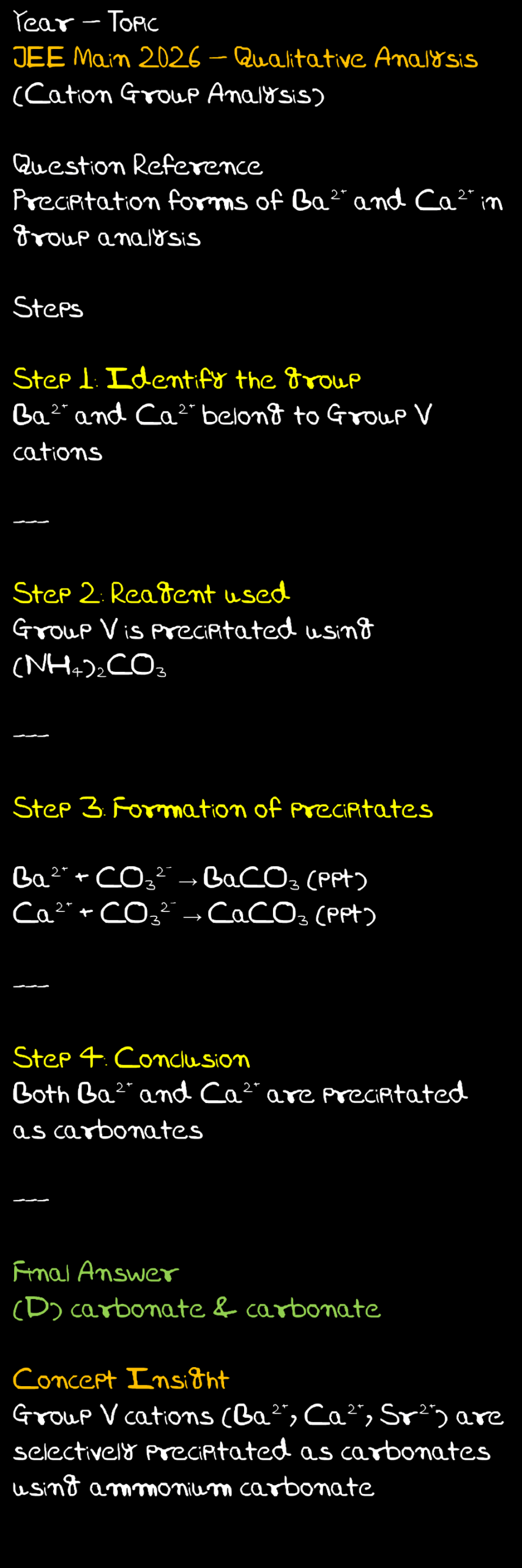
- In group analysis, ammonium carbonate is used for this stage
- This precipitates Ba²⁺ and Ca²⁺ as carbonates
Step 3: Write the Precipitated Forms
- Ba²⁺ + CO₃²⁻ → BaCO₃
- Ca²⁺ + CO₃²⁻ → CaCO₃
Step 4: Match with the Given Options
- Ba²⁺ is precipitated as carbonate
- Ca²⁺ is also precipitated as carbonate
So the correct option is:
(D) carbonate & carbonate
Final Answer
Option (D): carbonate & carbonate ✓
In cation group analysis, both Ba²⁺ and Ca²⁺ are precipitated as their carbonates.
Essential Formulas for This Topic
Primary Reactions
- Barium Carbonate Formation:
- Ba²⁺ + CO₃²⁻ → BaCO₃
- BaCO₃ is insoluble
- Hence it precipitates
- Calcium Carbonate Formation:
- Ca²⁺ + CO₃²⁻ → CaCO₃
- CaCO₃ is insoluble
- Hence it precipitates
- Group Analysis Principle:
- Cations are separated by selective precipitation
- Group reagent gives insoluble salts
- Ba²⁺ and Ca²⁺ appear in carbonate precipitation stage
Important Constants
- Ba²⁺ and Ca²⁺ are precipitated in the carbonate group
- Ammonium carbonate is the common group reagent
- Solubility differences are the basis of qualitative analysis
- Carbonate precipitates are important in classical salt analysis
Common Mistakes to Avoid
❌ Mistake 1: Confusing Sulphide Group with Carbonate Group
Wrong Thinking: “Most cations in analysis are precipitated as sulphides.”
Correct Approach: Different cation groups have different reagents. Ba²⁺ and Ca²⁺ are precipitated as carbonates, not sulphides.
❌ Mistake 2: Mixing Hydroxide and Carbonate Precipitates
Wrong Approach: Choosing hydroxide for one and carbonate for the other
Correct Approach: Both Ba²⁺ and Ca²⁺ are precipitated in the same group as carbonates.
❌ Mistake 3: Relying Only on Memory Without Group Logic
Common Error:
- Forgetting the group reagent
- Randomly selecting a precipitate type
Correct Approach: Recall the group reagent first, then write the precipitated form.
❌ Mistake 4: Thinking Only One of Them Forms Carbonate
Wrong Thinking: “Ba²⁺ forms carbonate but Ca²⁺ forms something else.”
Correct Understanding:
- Both belong to the same stage in classical cation group analysis
- Both give insoluble carbonates
- So both are precipitated as carbonates
Key Concept Summary
What You Must Remember
- Salt analysis uses selective precipitation: Each cation group has a different reagent
- Ba²⁺ and Ca²⁺ are precipitated as carbonates: This is the key fact here
- Ammonium carbonate is the important reagent: It causes carbonate precipitation
- Do not confuse with sulphide group: That is a different cation group
- Both ions behave similarly in this step: So the answer is carbonate and carbonate
The Golden Rule for Cation Group Analysis Questions
“First identify the cation group, then recall the group reagent and the insoluble salt formed.”
Frequently Asked Questions
Q1: Why are Ba²⁺ and Ca²⁺ precipitated as carbonates?
A: Because in classical qualitative analysis they react with carbonate ions from ammonium carbonate to form insoluble carbonates.
Q2: What is the precipitate formed by Ba²⁺?
A: Ba²⁺ forms barium carbonate, BaCO₃.
Q3: What is the precipitate formed by Ca²⁺?
A: Ca²⁺ forms calcium carbonate, CaCO₃.
Q4: Why is sulphide not the correct answer here?
A: Because Ba²⁺ and Ca²⁺ are not precipitated in the sulphide group in standard salt analysis.
Q5: What is the final correct option?
A: The correct option is (D) carbonate and carbonate.
Prerequisites to Solve This Question
Before attempting this problem, you should understand:
- Basic salt analysis: Cation group separation method
- Insoluble salts: Why certain ions precipitate
- Group reagents: Common reagents used in qualitative analysis
- Carbonate precipitation: For alkaline earth cations in group analysis
- Qualitative inorganic chemistry basics: Standard JEE salt analysis facts
After Solving This, You Can:
✅ Recall the precipitated forms of Ba²⁺ and Ca²⁺ confidently
✅ Use group analysis logic in JEE Main salt analysis questions
✅ Avoid mixing sulphide, hydroxide and carbonate groups
✅ Solve qualitative analysis fact-based questions faster
✅ Remember important salt analysis reagents more clearly
✅ Strengthen memory for classical cation group separation
Study Tips for This Topic
For JEE Main:
- Memorize group reagents: They are frequently asked in one-line conceptual questions
- Link each cation group with precipitate type: This improves retention
- Practice direct fact-based MCQs: Salt analysis often appears this way in JEE Main
- Revise standard precipitates repeatedly: These are easy marks if remembered properly
Common JEE Variants:
- Group reagent for a cation group
- Precipitated form of a cation
- Confirmatory test in salt analysis
- Difference between group analysis reagents
Difficulty Rating & Exam Frequency
Difficulty Level: ⭐⭐ (2/5) – Easy
JEE Main Frequency: Medium – Salt analysis factual questions appear regularly
JEE Advanced Frequency: Low – Usually less direct than JEE Main
Topic Importance: High – Salt analysis can give quick scoring conceptual questions
Written by Nishant Kumar
Chemistry Educator with 10+ Years of Experience Teaching JEE Aspirants
Founder – PadhoLikhoJEE
Last Updated: March 2026
Question Source: JEE Main 2026 PYQ
Topic: Salt Analysis – Group Analysis of Cations