
Hydrocarbon Hyperconjugation Stability of Alkene Question JEE Main 2026
Quick Summary
Question Type: Alkene stability order and hyperconjugation comparison
Chapter: Hydrocarbon – Stability of Alkenes
Difficulty: ⭐⭐ Easy
Time to Solve: 2-3 minutes
Key Formula: More substituted alkene is generally more stable; trans > cis for the same degree of substitution
Correct Answer: (C) I > III > II > IV
Why: Alkene stability increases with substitution due to hyperconjugation. So tetra-substituted alkene I is most stable, then tri-substituted III, then trans-di-substituted II, and cis-di-substituted IV is least stable.
The Question
JEE Main 2026 (24 January Morning Shift) – Hydrocarbon
Arrange the following alkenes in decreasing order of stability.
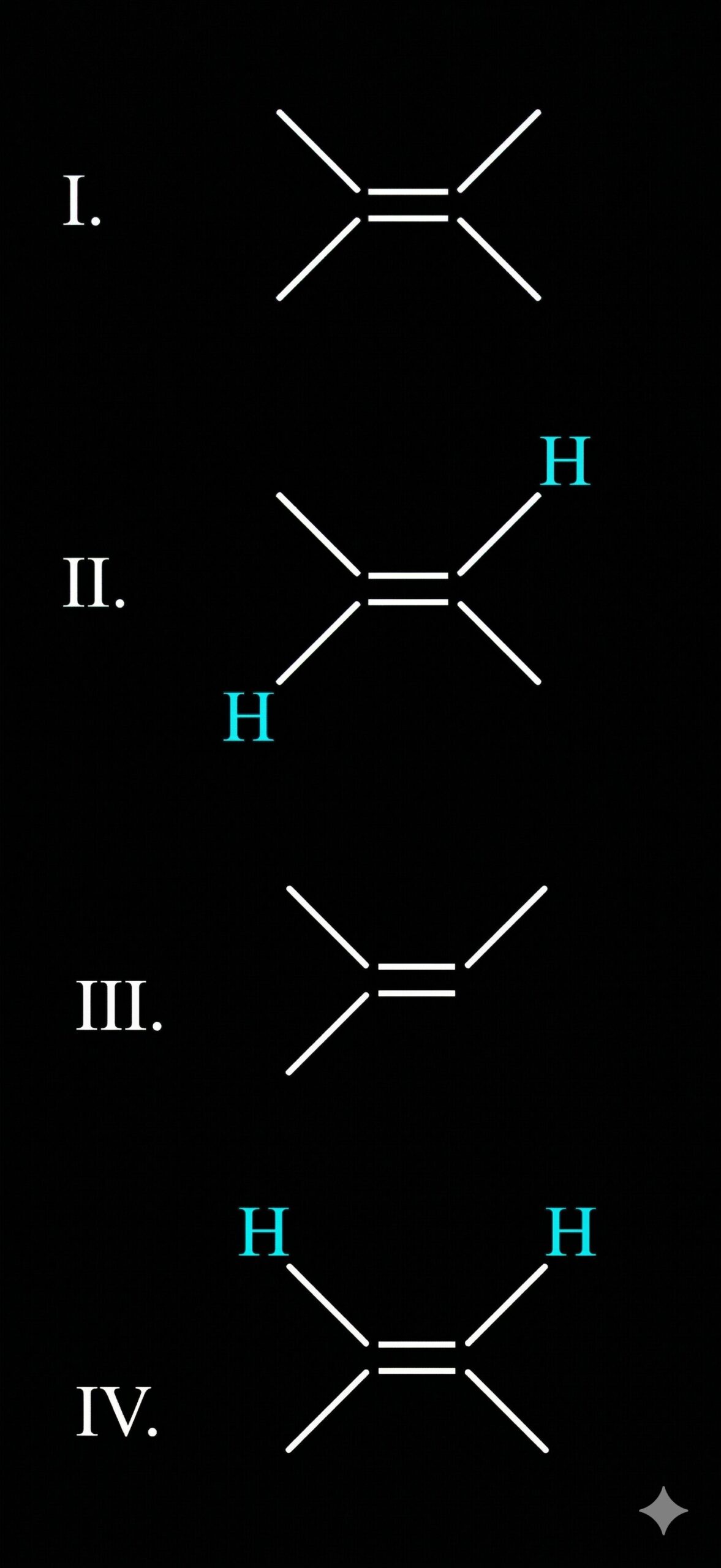
Choose the correct answer from the options given below:
(A) III > I > II > IV
(B) III > II > I > IV
(C) I > III > II > IV
(D) I > III > IV > II
Quick Answer
Correct Option: (C) I > III > II > IV
Reasoning: Stability of alkenes depends mainly on:
- degree of substitution around the double bond
- hyperconjugation
- cis-trans effect for similarly substituted alkenes
So the order becomes:
- I = tetra-substituted alkene, most stable
- III = tri-substituted alkene
- II = trans-di-substituted alkene
- IV = cis-di-substituted alkene, least stable among these
Therefore, the decreasing order of stability is I > III > II > IV.
Video Solution
If you want the full explanation in a clear step-by-step teaching format, watch the video solution below:
Watch Full Video Solution on YouTube
Understanding the Concept
Why More Substituted Alkenes Are More Stable
Alkenes become more stable when more alkyl groups are attached to the double-bonded carbons. This happens mainly because alkyl groups provide electron density through hyperconjugation and the +I effect.
Stability: tetra-substituted > tri-substituted > trans-di-substituted > cis-di-substituted
For alkenes with the same substitution level, the trans form is generally more stable than the cis form because steric repulsion is lower.
The Key Principle
- First compare the degree of substitution of the double bond
- Then compare cis and trans forms if substitution is similar
- Higher hyperconjugation means higher alkene stability
Detailed Step-by-Step Solution
Step 1: Identify the Type of Each Alkene
- I is tetra-substituted
- III is tri-substituted
- II is trans-di-substituted
- IV is cis-di-substituted
Step 2: Apply Stability Rule
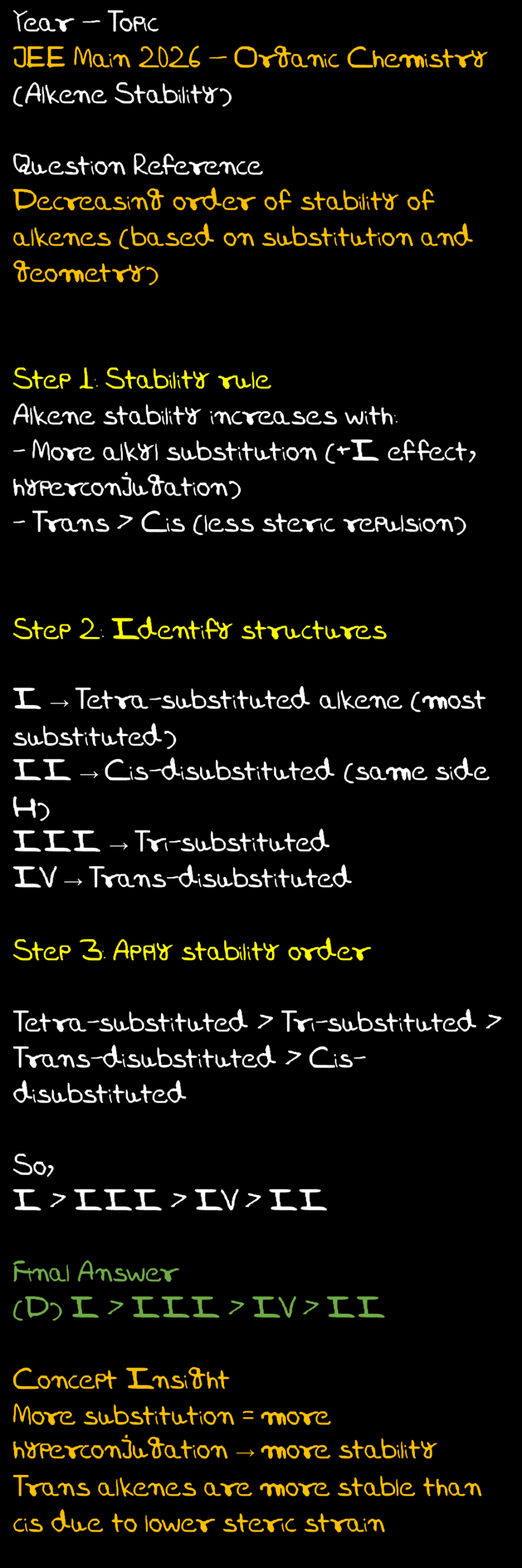
- Tetra-substituted alkene has maximum hyperconjugation, so it is most stable
- Tri-substituted alkene is next in stability
- Between cis and trans disubstituted alkenes, trans is more stable than cis
Step 3: Compare II and IV Carefully
- Both II and IV are disubstituted alkenes
- II is trans, so steric repulsion is smaller
- IV is cis, so steric repulsion is larger
- Hence II is more stable than IV
Step 4: Write Final Order
- I > III > II > IV
So the correct option is (C).
Final Answer
Option (C): I > III > II > IV ✓
The correct decreasing order of alkene stability is I > III > II > IV.
Essential Formulas for This Topic
Primary Rules
- Substitution Stability Rule:
- tetra-substituted > tri-substituted > di-substituted > mono-substituted
- More alkyl groups increase stability
- Reason: hyperconjugation and +I effect
- Cis-Trans Stability Rule:
- trans alkene is more stable than cis alkene
- Trans arrangement has less steric hindrance
- This applies when degree of substitution is the same
- Hyperconjugation Rule:
- More alpha C-H bonds around the double bond increase stability
- Greater hyperconjugation means greater alkene stability
- Highly substituted alkenes show stronger stabilization
Important Constants
- Hyperconjugation stabilizes alkenes
- Alkyl groups donate electron density toward the double bond
- Trans alkenes usually have less steric strain than cis alkenes
- Substitution and stereochemistry both affect alkene stability
Common Mistakes to Avoid
❌ Mistake 1: Ignoring Degree of Substitution
Wrong Thinking: “Only cis/trans matters here.”
Correct Approach: First compare substitution. Tetra-substituted and tri-substituted alkenes are more stable than disubstituted ones.
❌ Mistake 2: Reversing Cis and Trans Stability
Wrong Approach: Taking cis alkene as more stable than trans alkene
Correct Approach: For similarly substituted alkenes, trans is generally more stable because it has lower steric repulsion.
❌ Mistake 3: Using Only Visual Size Without Concept
Common Error:
- Trying to guess from appearance only
- Not identifying whether the alkene is tetra-, tri-, or di-substituted
Correct Approach: Count the alkyl substituents attached to the double-bonded carbons first.
❌ Mistake 4: Forgetting Hyperconjugation
Wrong Thinking: “All substituted alkenes have almost same stability.”
Correct Understanding:
- More substituted alkenes have more hyperconjugative stabilization
- This strongly affects stability order
- That is why I and III are more stable than II and IV
Key Concept Summary
What You Must Remember
- More substituted alkene is more stable: Due to hyperconjugation
- Tetra-substituted is most stable: It has maximum alkyl substitution
- Trans is more stable than cis: When substitution is same
- Hyperconjugation is the main idea: It stabilizes the double bond
- Always identify alkene type first: Then compare stereochemistry
The Golden Rule for Alkene Stability Questions
“First compare substitution, then compare cis/trans if needed.”
Frequently Asked Questions
Q1: Why is alkene I most stable?
A: Because it is tetra-substituted and has maximum hyperconjugative stabilization.
Q2: Why is alkene III more stable than II?
A: Because III is tri-substituted while II is only disubstituted.
Q3: Why is trans alkene II more stable than cis alkene IV?
A: Because trans arrangement reduces steric repulsion between substituents.
Q4: What is the role of hyperconjugation here?
A: Hyperconjugation donates electron density and stabilizes the double bond more in highly substituted alkenes.
Q5: What is the final decreasing order of stability?
A: I > III > II > IV.
Prerequisites to Solve This Question
Before attempting this problem, you should understand:
- Alkene structure: Identifying substituents around a double bond
- Hyperconjugation: Its role in stability
- Inductive effect: Basic electron-donating effect of alkyl groups
- Cis-trans isomerism: Stability difference between geometric isomers
- Organic comparison logic: Ranking structures systematically
After Solving This, You Can:
✅ Compare stability of substituted alkenes confidently
✅ Use hyperconjugation in Hydrocarbon questions
✅ Distinguish cis and trans alkene stability
✅ Solve JEE Main alkene stability MCQs faster
✅ Avoid common substitution-counting mistakes
✅ Apply the same logic to other unsaturation stability problems
Study Tips for This Topic
For JEE Main:
- Memorize the substitution order: tetra > tri > di > mono
- Remember trans > cis: For same substitution level
- Practice visual counting: Count alkyl groups around double bond quickly
- Revise hyperconjugation examples: JEE often asks stability through this idea
Common JEE Variants:
- Arrange alkenes in order of stability
- Compare cis and trans alkene stability
- Hyperconjugation-based order questions
- Most stable or least stable alkene among given options
Difficulty Rating & Exam Frequency
Difficulty Level: ⭐⭐ (2/5) – Easy
JEE Main Frequency: High – Alkene stability questions are common in Hydrocarbon
JEE Advanced Frequency: Medium – Often combined with mechanistic or thermodynamic reasoning
Topic Importance: Very High – Hyperconjugation and stability are core concepts in organic chemistry
Written by Nishant Kumar
Chemistry Educator with 10+ Years of Experience Teaching JEE Aspirants
Founder – PadhoLikhoJEE
Last Updated: March 2026
Question Source: JEE Main 2026 PYQ
Topic: Hydrocarbon – Stability of Alkenes