
Electrochemistry Kohlrausch Law Constant JEE Main 2026
Quick Summary
Question Type: Molar conductivity vs concentration for strong electrolyte
Chapter: Electrochemistry – Kohlrausch Law
Difficulty: ⭐⭐⭐ Medium
Time to Solve: 3-4 minutes
Key Formula: Λm = Λm0 − A√C (strong electrolyte)
Correct Answer: 4
Why: A = (Λ1 − Λ2) / (√C2 − √C1) = (96.1 − 95.7) / (0.3 − 0.2) = 0.4 / 0.1 = 4
The Question
JEE Main 2026 – Electrochemistry
Given the molar conductivity data for a strong electrolyte:
At C = 0.04, Molar Conductivity = 96.1
At C = 0.09, Molar Conductivity = 95.7
Find the value of the constant A.
Quick Answer
Correct Answer: 4
Reasoning: For a strong electrolyte, Λm = Λm0 − A√C. Using two given points, A is obtained from the slope: 0.4 / 0.1 = 4.
Video Solution
If you want the full explanation in a clear step-by-step teaching format, watch the video solution below:
Watch Full Video Solution on YouTube
Understanding the Concept
Kohlrausch Law for Strong Electrolytes
For strong electrolytes, molar conductivity decreases linearly with √C. The constant A represents the slope of this line and is found using two conductivity values at different concentrations.
The Key Principle
Use the two-point form:
A = (Λ1 − Λ2) / (√C2 − √C1)
Detailed Step-by-Step Solution
Step 1: Write the Relation
Λm = Λm0 − A√C
Step 2: Compute √C Values
- √0.04 = 0.2
- √0.09 = 0.3
Step 3: Apply Two-Point Formula
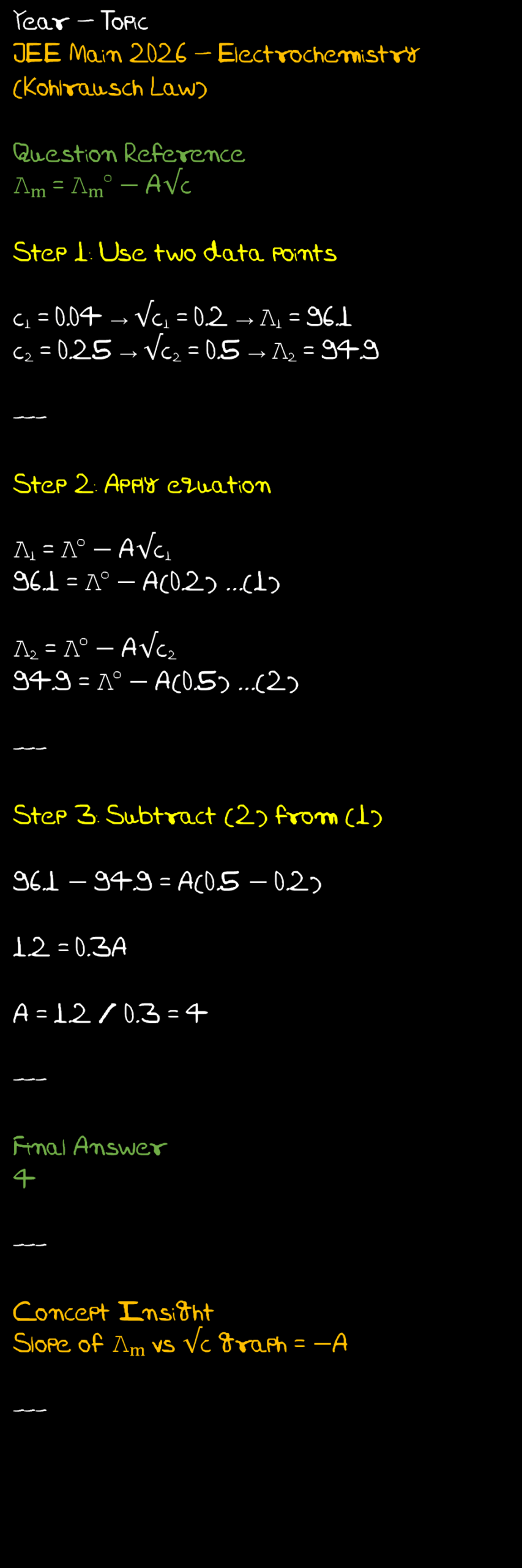
- Λ1 = 96.1 at √C = 0.2
- Λ2 = 95.7 at √C = 0.3
- A = (96.1 − 95.7) / (0.3 − 0.2) = 0.4 / 0.1 = 4
Step 4: Final Answer
The constant A is 4.
Final Answer
4 ✓
Essential Formulas for This Topic
Primary Rules
- Λm = Λm0 − A√C
- A = (Λ1 − Λ2) / (√C2 − √C1)
Common Mistakes to Avoid
❌ Mistake 1: Using C Instead of √C
Wrong Thinking: Using C directly in the equation.
Correct Approach: For strong electrolytes, the relation is linear in √C, not C.
❌ Mistake 2: Swapping the Points Incorrectly
Wrong Thinking: Mixing Λ and √C from different data points.
Correct Approach: Keep each Λ value paired with its own √C.
Key Concept Summary
- Strong electrolyte obeys Λm = Λm0 − A√C
- A is obtained from the slope of Λ vs √C
- Here, A = 4
Frequently Asked Questions
Q1: Why do we use √C instead of C?
A: Because Kohlrausch’s law for strong electrolytes predicts a linear decrease with √C.
Q2: What is the value of A?
A: 4.
Prerequisites to Solve This Question
- Kohlrausch law for strong electrolytes
- Basic square root calculation
- Two-point slope calculation
After Solving This, You Can:
✅ Apply Kohlrausch law to strong electrolytes
✅ Find A from conductivity data
✅ Avoid common √C mistakes
Study Tips for This Topic
For JEE Main:
- Memorize the strong electrolyte relation with √C
- Use two-point slope form for A
- Keep units and data pairs consistent
Difficulty Rating & Exam Frequency
Difficulty Level: ⭐⭐⭐ (3/5) – Medium
JEE Main Frequency: Medium
JEE Advanced Frequency: Low to Medium
Topic Importance: High
Written by Nishant Kumar Gupta
Chemistry Educator with 12+ Years of Experience Teaching JEE Aspirants
Founder – PadhoLikhoJEE
Last Updated: April 2026
Question Source: JEE Main 2026 PYQ
Topic: Electrochemistry – Kohlrausch Law