
Mole Concept Percentage Composition Question JEE Main 2026
Quick Summary
Question Type: Usual analysis and percentage composition calculation
Chapter: Mole Concept – Percentage Composition
Difficulty: ⭐⭐⭐ Medium
Time to Solve: 4-5 minutes
Key Formula: Percentage of element = (mass of element obtained from analysis / mass of sample) × 100
Correct Answer: (D) 50
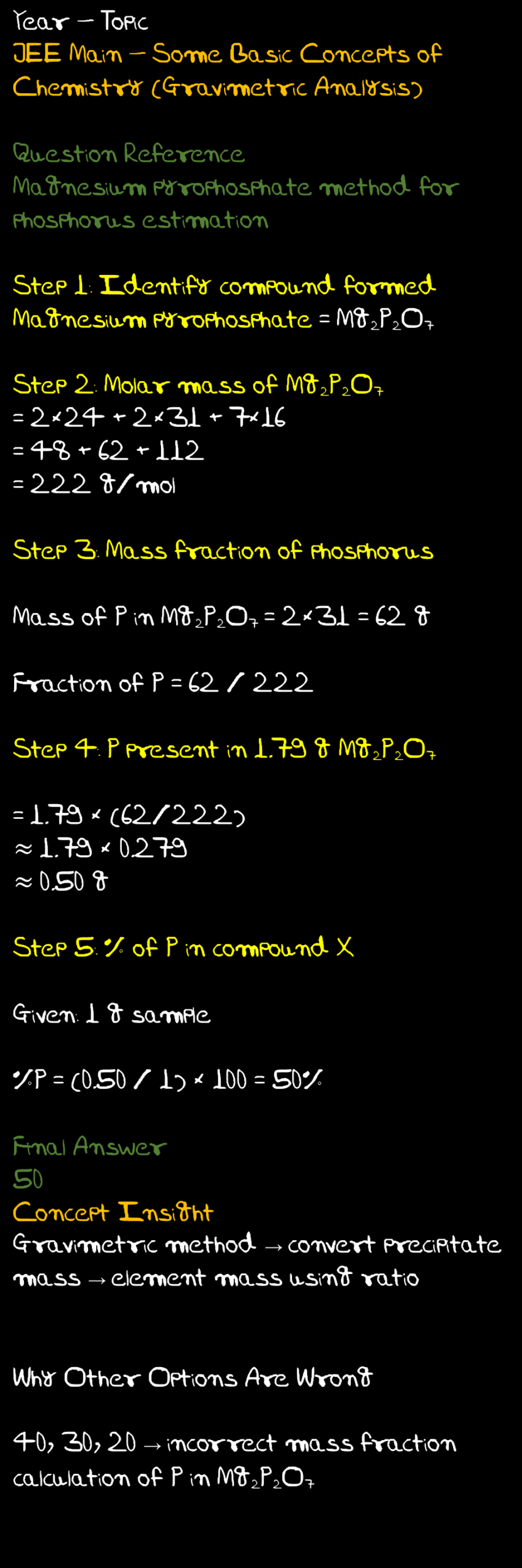
Why: 1.79 g of magnesium pyrophosphate is Mg2P2O7. Its molar mass is 222 g mol−1, and phosphorus contributes 62 g per mole. So phosphorus mass = 1.79 × (62/222) ≈ 0.50 g. In a 1.00 g sample, percentage of phosphorus = 50%.
The Question
JEE Main 2026 (Online) Evening Shift – Mole Concept
By usual analysis, 1.00 g of compound (X) gave 1.79 g of magnesium pyrophosphate. The percentage of phosphorus in compound (X) is: (nearest integer)
Given: molar mass in g mol−1: O = 16, Mg = 24, P = 31
Choose the correct answer from the options given below:
(A) 40
(B) 30
(C) 20
(D) 50
Quick Answer
Correct Option: (D) 50
Reasoning: Magnesium pyrophosphate has the formula Mg2P2O7.
Its molar mass is:
- 2 × 24 + 2 × 31 + 7 × 16 = 222 g mol−1
Mass of phosphorus in 222 g of Mg2P2O7 is:
- 2 × 31 = 62 g
So phosphorus present in 1.79 g of Mg2P2O7 is:
- 1.79 × 62/222 ≈ 0.50 g
Since the original compound sample is 1.00 g, percentage of phosphorus is:
- (0.50/1.00) × 100 = 50%
Therefore, the correct answer is (D) 50.
Why Other Options Are Wrong
- Option A (40): Incorrect because the phosphorus mass calculated from Mg2P2O7 comes close to 0.50 g, not 0.40 g.
- Option B (30): Incorrect because this underestimates the phosphorus content significantly.
- Option C (20): Incorrect because it ignores the actual phosphorus mass contribution in magnesium pyrophosphate.
- Option D (50): Correct because the phosphorus content is approximately 49.95%, nearest integer 50.
Video Solution
If you want the full explanation in a clear step-by-step teaching format, watch the video solution below:
Watch Full Video Solution on YouTube
Understanding the Concept
How Usual Analysis Questions Work
In usual analysis questions, the element in the unknown compound is converted into a known stable compound. Then we use the mass of that known compound to calculate how much of the target element was originally present.
Here, phosphorus is finally obtained in the form of:
- magnesium pyrophosphate = Mg2P2O7
So the main task is:
- find molar mass of Mg2P2O7
- find how much phosphorus it contains
- use that fraction to calculate percentage in the original sample
The Key Principle
- Find the formula and molar mass of the final compound
- Find mass of the required element in 1 mole of that compound
- Use mass ratio to calculate the required percentage
Detailed Step-by-Step Solution
Step 1: Write the Formula of Magnesium Pyrophosphate
- Magnesium pyrophosphate = Mg2P2O7
Step 2: Calculate Its Molar Mass
- 2 × Mg = 2 × 24 = 48
- 2 × P = 2 × 31 = 62
- 7 × O = 7 × 16 = 112
So molar mass is:
- 48 + 62 + 112 = 222 g mol−1
Step 3: Find the Mass of Phosphorus in 1.79 g of Mg2P2O7
In 222 g of Mg2P2O7, mass of phosphorus = 62 g.
So in 1.79 g:
- Mass of P = 1.79 × 62/222
- Mass of P ≈ 0.4995 g
Step 4: Calculate Percentage of Phosphorus in Compound X
- Original sample mass = 1.00 g
- Mass of phosphorus in sample ≈ 0.4995 g
Therefore:
- Percentage of P = (0.4995/1.00) × 100
- Percentage of P ≈ 49.95%
Nearest integer:
- 50%
Step 5: Write Final Answer
So the correct option is (D).
Final Answer
Option (D): 50 ✓
The percentage of phosphorus in compound (X) is 50%.
Essential Formulas for This Topic
Primary Rules
- Percentage Formula:
- Percentage of element = (mass of element / mass of sample) × 100
- Mass Ratio Rule:
- Mass of element in compound = given mass × (mass of element in 1 mole / molar mass of compound)
- Usual Analysis Logic:
- Convert the unknown compound data into a known compound formula and then use stoichiometric mass relation
Important Notes
- Magnesium pyrophosphate formula must be written correctly as Mg2P2O7
- Phosphorus contributes 62 g in 222 g of Mg2P2O7
- The final answer must be rounded to the nearest integer
Common Mistakes to Avoid
❌ Mistake 1: Writing the Wrong Formula of Magnesium Pyrophosphate
Wrong Thinking: “Magnesium pyrophosphate may be MgPO4 or Mg3(PO4)2.”
Correct Approach: Use the correct formula given by usual analysis result: Mg2P2O7.
❌ Mistake 2: Using Wrong Molar Mass
Wrong Thinking: “Only phosphorus mass matters, so total molar mass is not needed.”
Correct Approach: First calculate full molar mass of Mg2P2O7, then use phosphorus mass fraction.
❌ Mistake 3: Forgetting There Are Two Phosphorus Atoms
Wrong Thinking: “Mass of phosphorus is 31 g in one mole of Mg2P2O7.”
Correct Approach: There are two phosphorus atoms, so total phosphorus mass is 62 g.
❌ Mistake 4: Not Rounding to the Nearest Integer
Wrong Thinking: “49.95 is not exactly 50, so answer cannot be 50.”
Correct Approach: The question asks for the nearest integer, so 49.95 becomes 50.
Key Concept Summary
- Identify the final compound correctly: Mg2P2O7
- Find its molar mass: 222 g mol−1
- Find phosphorus mass in it: 62 g per mole
- Use mass fraction: 1.79 × 62/222 gives phosphorus mass
- Final percentage is 50%: nearest integer value
The Golden Rule for Usual Analysis Questions
“Find the formula of the final compound first, then use the element’s mass fraction to calculate percentage.”
Frequently Asked Questions
Q1: What is the formula of magnesium pyrophosphate?
A: Mg2P2O7.
Q2: Why is phosphorus mass taken as 62 g?
A: Because there are two phosphorus atoms in Mg2P2O7, so total mass = 2 × 31 = 62 g.
Q3: What is the molar mass of Mg2P2O7?
A: 222 g mol−1.
Q4: How is the percentage of phosphorus calculated?
A: First find mass of phosphorus in 1.79 g of Mg2P2O7, then divide by original sample mass and multiply by 100.
Q5: What is the correct answer?
A: Option (D), 50.
Prerequisites to Solve This Question
- Mole concept: Basic molar mass calculation
- Percentage composition: Element mass percentage formula
- Formula interpretation: Reading atomic count in compounds correctly
- Ratio method: Using mass fraction from a known compound
After Solving This, You Can:
✅ Solve usual analysis based percentage questions
✅ Calculate element percentage from precipitate mass
✅ Use molar mass and mass fraction confidently
✅ Avoid common percentage composition mistakes
Study Tips for This Topic
For JEE Main:
- Memorize the percentage formula: It saves time in direct calculation questions
- Always count atoms carefully: Missing one phosphorus atom can change the whole answer
- Write the molar mass step clearly: It reduces silly mistakes
- Read the final instruction: Questions may ask for nearest integer
Common JEE Variants:
- Percentage of an element from usual analysis
- Mass of precipitate based composition questions
- Formula-based mass fraction problems
- Nearest integer Mole Concept questions
Difficulty Rating & Exam Frequency
Difficulty Level: ⭐⭐⭐ (3/5) – Medium
JEE Main Frequency: Medium – Percentage composition and usual analysis appear regularly in Mole Concept
JEE Advanced Frequency: Low to Medium – Usually combined with analytical chemistry ideas
Topic Importance: High – Builds strong command over composition and mass relation problems
Written by Nishant Kumar Gupta
Chemistry Educator with 12+ Years of Experience Teaching JEE Aspirants
Founder – PadhoLikhoJEE
Last Updated: April 2026
Question Source: JEE Main 2026 PYQ
Topic: Mole Concept – Percentage Composition by Usual Analysis