
Mole Concept Stoichiometry Question JEE Main 2026
Quick Summary
Question Type: Stoichiometry and mass calculation of product
Chapter: Mole Concept – Stoichiometry
Difficulty: ⭐⭐ Easy
Time to Solve: 3-4 minutes
Key Formula: Moles = mass / molar mass; use balanced equation to convert reactant moles into product moles
Correct Answer: (C) 7.1 g
Why: The balanced reaction is MnO2 + 4HCl → MnCl2 + Cl2 + 2H2O. Molar mass of MnO2 = 87 g mol−1, so 8.7 g corresponds to 0.1 mol. From the equation, 1 mol MnO2 gives 1 mol Cl2. Therefore 0.1 mol Cl2 is formed, whose mass is 0.1 × 71 = 7.1 g.
The Question
JEE Main 2026 (Online) 21 January Evening Shift – Mole Concept
Aqueous HCl reacts with MnO2(s) to form MnCl2(aq), Cl2(g), and H2O(l). What is the weight (in g) of Cl2 liberated when 8.7 g of MnO2(s) is reacted with excess aqueous HCl solution?
Given: molar mass in g mol−1: Mn = 55, Cl = 35.5, O = 16, H = 1
Choose the correct answer from the options given below:
(A) 14.2
(B) 21.3
(C) 7.1
(D) 71
Quick Answer
Correct Option: (C) 7.1
Reasoning: First write the balanced equation:
- MnO2 + 4HCl → MnCl2 + Cl2 + 2H2O
Now find moles of MnO2:
- Molar mass of MnO2 = 55 + 2×16 = 87 g mol−1
- Moles of MnO2 = 8.7/87 = 0.1 mol
From the balanced equation:
- 1 mol MnO2 gives 1 mol Cl2
- So 0.1 mol MnO2 gives 0.1 mol Cl2
Mass of Cl2:
- Molar mass of Cl2 = 2 × 35.5 = 71 g mol−1
- Mass = 0.1 × 71 = 7.1 g
Therefore, the correct answer is (C) 7.1 g.
Why Other Options Are Wrong
- Option A (14.2): Incorrect because this would correspond to 0.2 mol of Cl2, but only 0.1 mol MnO2 is present.
- Option B (21.3): Incorrect because it overestimates the product formed from the given amount of MnO2.
- Option C (7.1): Correct because 0.1 mol of Cl2 is formed and its mass is 7.1 g.
- Option D (71): Incorrect because 71 g is the mass of 1 mol of Cl2, not 0.1 mol.
Video Solution
If you want the full explanation in a clear step-by-step teaching format, watch the video solution below:
Watch Full Video Solution on YouTube
Understanding the Concept
How to Solve Stoichiometry Questions Like This
These questions are straightforward if you follow the correct sequence:
- write the balanced equation
- calculate moles of the given reactant
- use the mole ratio from the equation
- convert final moles into mass
Since HCl is given in excess, MnO2 becomes the only reactant that controls the amount of Cl2 formed.
The Key Principle
- Balanced equation gives mole ratio
- Given mass must first be converted to moles
- Excess reactant does not limit product formation
- Final mass = moles × molar mass
Detailed Step-by-Step Solution
Step 1: Write the Balanced Equation
- MnO2 + 4HCl → MnCl2 + Cl2 + 2H2O
This shows:
- 1 mol MnO2 gives 1 mol Cl2
Step 2: Calculate Moles of MnO2
- Molar mass of MnO2 = 55 + 2×16 = 87 g mol−1
- Given mass = 8.7 g
- Moles of MnO2 = 8.7/87 = 0.1 mol
Step 3: Use the Stoichiometric Ratio
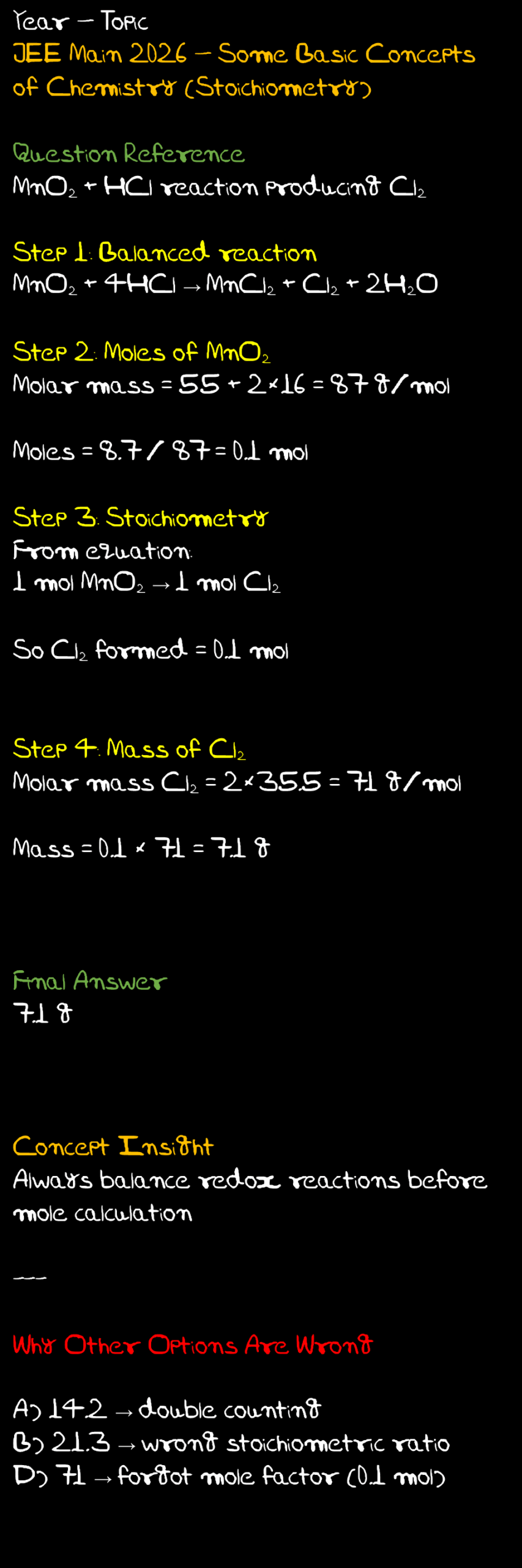
From the equation:
- 1 mol MnO2 gives 1 mol Cl2
- So 0.1 mol MnO2 gives 0.1 mol Cl2
Step 4: Convert Cl2 Moles into Mass
- Molar mass of Cl2 = 2 × 35.5 = 71 g mol−1
- Mass of Cl2 = 0.1 × 71 = 7.1 g
Step 5: Write Final Answer
So the correct option is (C).
Final Answer
Option (C): 7.1 ✓
The weight of Cl2 liberated is 7.1 g.
Essential Formulas for This Topic
Primary Rules
- Mole Formula:
- Number of moles = given mass / molar mass
- Stoichiometric Ratio Rule:
- Use coefficients from balanced equation to relate reactants and products
- Mass Formula:
- Mass = moles × molar mass
Important Notes
- HCl is in excess, so MnO2 controls the amount of product formed
- 1 mole of MnO2 gives exactly 1 mole of Cl2
- Molar mass of Cl2 must be taken as 71 g mol−1
Common Mistakes to Avoid
❌ Mistake 1: Not Writing the Balanced Equation
Wrong Thinking: “I can directly guess the product mass from the given values.”
Correct Approach: Always begin with the balanced reaction before applying mole ratio.
❌ Mistake 2: Using Wrong Molar Mass of MnO2
Wrong Thinking: “MnO2 molar mass is 71 or 87? I’ll approximate.”
Correct Approach: Carefully calculate 55 + 32 = 87 g mol−1.
❌ Mistake 3: Forgetting HCl Is in Excess
Wrong Thinking: “I must calculate moles of both reactants.”
Correct Approach: Since HCl is in excess, MnO2 alone decides how much Cl2 forms.
❌ Mistake 4: Taking 71 g as the Final Answer Directly
Wrong Thinking: “Molar mass of Cl2 is 71, so answer is 71.”
Correct Approach: 71 g is for 1 mole of Cl2, but only 0.1 mol is formed here.
Key Concept Summary
- Balance the equation first: It gives the exact mole ratio.
- Convert mass into moles: 8.7 g MnO2 = 0.1 mol.
- Use the reaction ratio: 1 mol MnO2 gives 1 mol Cl2.
- Find product mass: 0.1 mol Cl2 = 7.1 g.
- Final answer is 7.1 g: Option (C).
The Golden Rule for Stoichiometry Questions
“Convert the given mass to moles first, then use the balanced equation to find product amount.”
Frequently Asked Questions
Q1: Why is MnO2 the deciding reactant here?
A: Because HCl is given in excess, so MnO2 limits the amount of Cl2 formed.
Q2: What is the molar mass of MnO2?
A: 87 g mol−1.
Q3: How many moles of Cl2 are formed?
A: 0.1 mol.
Q4: Why is the final answer not 71 g?
A: Because 71 g is the mass of 1 mole of Cl2, while only 0.1 mole is formed.
Q5: What is the correct answer?
A: Option (C), 7.1 g.
Prerequisites to Solve This Question
- Mole concept: Converting mass into moles
- Balanced equations: Reading stoichiometric coefficients correctly
- Molar mass calculation: Finding formula mass from atomic masses
- Stoichiometric mass relation: Converting reactant amount into product amount
After Solving This, You Can:
✅ Solve basic stoichiometry questions confidently
✅ Convert moles into mass correctly
✅ Use balanced equations more effectively
✅ Avoid common Mole Concept calculation mistakes
Study Tips for This Topic
For JEE Main:
- Always balance the equation first: Many errors begin from wrong stoichiometric ratio.
- Check which reactant is in excess: That immediately simplifies the problem.
- Write molar mass separately: It reduces silly calculation mistakes.
- Keep units clear: Distinguish grams, moles, and molar mass carefully.
Common JEE Variants:
- Mass of gaseous product formed
- Excess reagent based stoichiometry
- Mole to mass conversion questions
- Balanced equation application problems
Difficulty Rating & Exam Frequency
Difficulty Level: ⭐⭐ (2/5) – Easy
JEE Main Frequency: High – Basic stoichiometry is a common part of Mole Concept
JEE Advanced Frequency: Medium – Often combined with limiting reagent or redox concepts
Topic Importance: Very High – Stoichiometry is one of the most fundamental chemistry skills
Written by Nishant Kumar Gupta
Chemistry Educator with 12+ Years of Experience Teaching JEE Aspirants
Founder – PadhoLikhoJEE
Last Updated: April 2026
Question Source: JEE Main 2026 PYQ
Topic: Mole Concept – Stoichiometric Mass Calculation