
Mole Concept Limiting Reagent and Gas Evolution Question JEE Main 2026
Quick Summary
Question Type: Limiting reagent, product mass, and gas evolution statement-based question
Chapter: Mole Concept – Limiting Reagent and Stoichiometry
Difficulty: ⭐⭐⭐ Medium
Time to Solve: 3-4 minutes
Key Formula: Moles = mass / molar mass; at 273 K and 1 atm, 1 mole of gas occupies 22.4 L
Correct Answer: (B) Statement B is incorrect
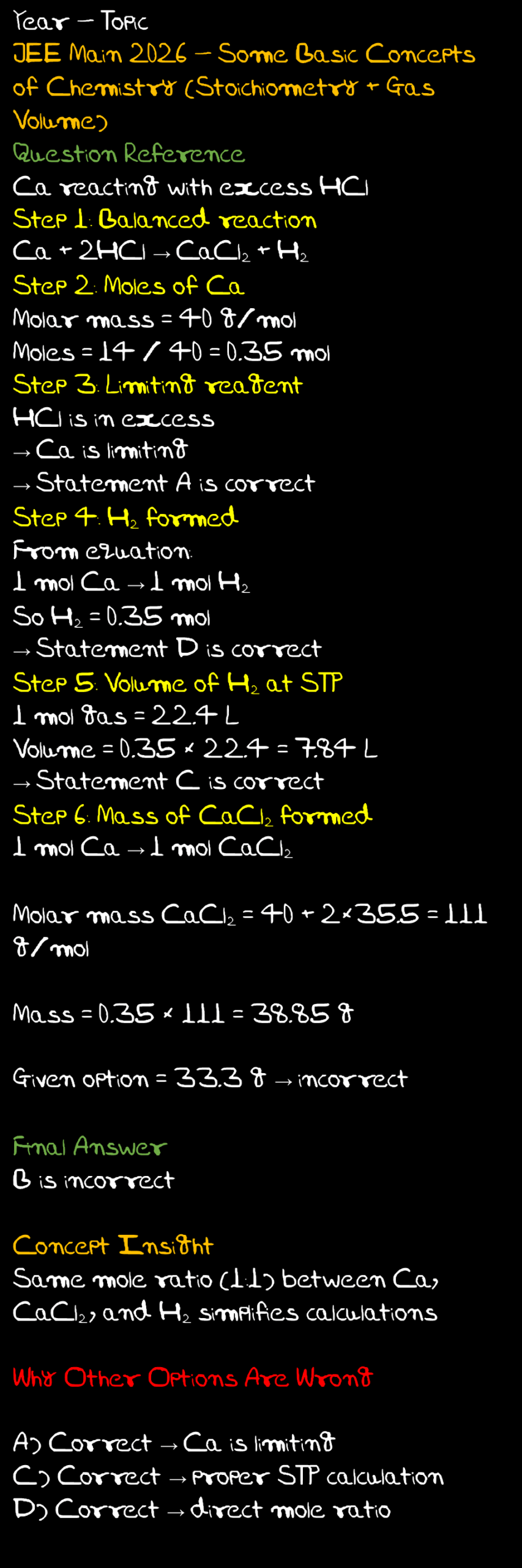
Why: Ca reacts with excess HCl according to Ca + 2HCl → CaCl2 + H2. 14.0 g Ca = 0.35 mol, so 0.35 mol H2 and 0.35 mol CaCl2 are formed. Mass of CaCl2 = 0.35 × 111 = 38.85 g, not 33.3 g. So statement B is the incorrect one.
The Question
JEE Main 2026 (Online) 21 January Morning Shift – Mole Concept
14.0 g of calcium metal is allowed to react with excess HCl at 1.0 atm pressure and 273 K. Which of the following statements is incorrect?
Given: molar mass in g mol−1 of Ca = 40, Cl = 35.5, H = 1
Choose the correct answer from the options given below:
(A) The limiting reagent is calcium metal.
(B) 33.3 g of CaCl2 is produced.
(C) 7.84 L of H2 gas is evolved.
(D) 0.35 mol of H2 gas is evolved.
Quick Answer
Correct Option: (B) Statement B is incorrect
Reasoning: First write the balanced equation:
- Ca + 2HCl → CaCl2 + H2
Now calculate moles of Ca:
- Moles of Ca = 14.0/40 = 0.35 mol
Since HCl is in excess:
- Ca is the limiting reagent
- 0.35 mol of Ca produces 0.35 mol of H2
- 0.35 mol of Ca produces 0.35 mol of CaCl2
Now check product mass:
- Molar mass of CaCl2 = 40 + 2×35.5 = 111 g mol−1
- Mass of CaCl2 = 0.35 × 111 = 38.85 g
So statement B is incorrect.
Why Other Options Are Correct
- Statement A: Correct because HCl is in excess, so calcium is the limiting reagent.
- Statement C: Correct because 0.35 mol H2 at 273 K and 1 atm occupies 0.35 × 22.4 = 7.84 L.
- Statement D: Correct because from the balanced equation, 1 mol Ca gives 1 mol H2, so 0.35 mol Ca gives 0.35 mol H2.
Video Solution
If you want the full explanation in a clear step-by-step teaching format, watch the video solution below:
Watch Full Video Solution on YouTube
Understanding the Concept
How to Solve This Type of Statement Question
In such problems, the balanced equation gives everything:
- which reactant is limiting
- how many moles of gas are formed
- how much product is produced
Since HCl is given in excess, calcium completely reacts and directly controls all product calculations.
The Key Principle
- Convert the given mass into moles
- Use the balanced equation to find product moles
- Convert gas moles into volume using 22.4 L at STP-like conditions
- Check each statement one by one
Detailed Step-by-Step Solution
Step 1: Write the Balanced Equation
- Ca + 2HCl → CaCl2 + H2
This shows:
- 1 mol Ca gives 1 mol CaCl2
- 1 mol Ca gives 1 mol H2
Step 2: Calculate Moles of Calcium
- Mass of Ca = 14.0 g
- Molar mass of Ca = 40 g mol−1
- Moles of Ca = 14.0/40 = 0.35 mol
Since HCl is in excess, Ca is the limiting reagent.
So statement A is correct.
Step 3: Calculate Moles and Volume of Hydrogen Gas
From the equation:
- 1 mol Ca gives 1 mol H2
- So 0.35 mol Ca gives 0.35 mol H2
At 273 K and 1 atm:
- 1 mol gas = 22.4 L
- Volume of H2 = 0.35 × 22.4 = 7.84 L
So:
- Statement C is correct
- Statement D is correct
Step 4: Calculate Mass of CaCl2
From the equation:
- 1 mol Ca gives 1 mol CaCl2
- So 0.35 mol Ca gives 0.35 mol CaCl2
Molar mass of CaCl2:
- 40 + 2×35.5 = 111 g mol−1
Mass of CaCl2:
- 0.35 × 111 = 38.85 g
So statement B is incorrect.
Step 5: Write Final Answer
Therefore, the incorrect statement is (B).
Final Answer
Option (B): 33.3 g of CaCl2 is produced ✗
The incorrect statement is (B), because the correct mass of CaCl2 formed is 38.85 g.
Essential Formulas for This Topic
Primary Rules
- Mole Formula:
- Number of moles = given mass / molar mass
- Stoichiometric Ratio Rule:
- Use the balanced equation to relate reactant and product moles
- Gas Volume Rule:
- At 273 K and 1 atm, 1 mol gas = 22.4 L
Important Notes
- Excess reagent does not control product formation
- 1 mol Ca gives 1 mol H2 and 1 mol CaCl2
- Mass and gas-volume statements should always be checked separately
Common Mistakes to Avoid
❌ Mistake 1: Not Identifying the Limiting Reagent
Wrong Thinking: “Since HCl is not numerically given, I should still compare both reactants.”
Correct Approach: If one reactant is explicitly in excess, the other is automatically the limiting reagent.
❌ Mistake 2: Using the Wrong Molar Mass of CaCl2
Wrong Thinking: “CaCl2 mass is close to 100 g mol−1, so approximation is fine.”
Correct Approach: Use exact molar mass: 40 + 2×35.5 = 111 g mol−1.
❌ Mistake 3: Wrong Gas Volume Conversion
Wrong Thinking: “0.35 mol H2 gives 0.35 L or 3.5 L.”
Correct Approach: Multiply 0.35 by 22.4 L mol−1 to get 7.84 L.
❌ Mistake 4: Missing That the Question Asks for Incorrect Statement
Wrong Thinking: “I found the correct calculations, so I’ll mark the correct statement.”
Correct Approach: Read the question carefully. Here you must identify the incorrect statement.
Key Concept Summary
- Calcium is limiting: HCl is in excess.
- 14.0 g Ca = 0.35 mol: This is the key starting point.
- 0.35 mol H2 is formed: From 1:1 mole ratio with Ca.
- Hydrogen volume is 7.84 L: At 273 K and 1 atm.
- Mass of CaCl2 is 38.85 g: So statement B is incorrect.
The Golden Rule for Statement-Based Stoichiometry Questions
“Use the balanced equation once, then verify every statement separately.”
Frequently Asked Questions
Q1: Why is calcium the limiting reagent?
A: Because HCl is given in excess, so calcium is completely consumed first.
Q2: How many moles of H2 are formed?
A: 0.35 mol.
Q3: What is the volume of hydrogen gas evolved?
A: 7.84 L at 273 K and 1 atm.
Q4: What is the correct mass of CaCl2 formed?
A: 38.85 g.
Q5: Which statement is incorrect?
A: Statement (B).
Prerequisites to Solve This Question
- Mole concept: Converting mass into moles
- Balanced equations: Understanding reaction coefficients
- Molar volume of gas: 22.4 L at 273 K and 1 atm
- Stoichiometric mass relation: Converting moles into product mass
After Solving This, You Can:
✅ Identify limiting reagent confidently
✅ Calculate product mass correctly
✅ Find gas moles and gas volume from reaction data
✅ Solve incorrect-statement Mole Concept questions faster
Study Tips for This Topic
For JEE Main:
- Spot the excess reagent quickly: It simplifies the whole question.
- Keep the 22.4 L value ready: It is used often in gas-volume questions.
- Check units carefully: Mole, gram, and liter conversions are common traps.
- Read the final command properly: “incorrect” and “correct” change the answer completely.
Common JEE Variants:
- Mass of salt formed
- Volume of gas evolved
- Limiting reagent identification
- Incorrect statement based stoichiometry questions
Difficulty Rating & Exam Frequency
Difficulty Level: ⭐⭐⭐ (3/5) – Medium
JEE Main Frequency: High – Stoichiometry and gas evolution are common Mole Concept themes
JEE Advanced Frequency: Medium – Often combined with redox or multi-step logic
Topic Importance: Very High – This is a core application of mole concept
Written by Nishant Kumar Gupta
Chemistry Educator with 12+ Years of Experience Teaching JEE Aspirants
Founder – PadhoLikhoJEE
Last Updated: April 2026
Question Source: JEE Main 2026 PYQ
Topic: Mole Concept – Limiting Reagent, Product Mass and Gas Evolution