
Aldehyde Ketone and Carboxylic Acid Acidic Strength Order Question JEE Main 2026
Quick Summary
Question Type: Identification of products followed by acidic strength comparison
Chapter: Aldehyde, Ketone and Carboxylic Acid
Difficulty: ⭐⭐⭐ Medium
Time to Solve: 4-5 minutes
Key Formula: Acidic strength depends on stability of conjugate base; electron-withdrawing effect increases acidity, while electron-donating alkyl groups decrease acidity
Correct Answer: (A) C > A > D > B
Why: The products are A = benzoic acid, B = propanoic acid, C = formic acid, and D = phenylacetic acid. Their acidic strength follows the order formic acid > benzoic acid > phenylacetic acid > propanoic acid.
The Question
JEE Main 2026 (Online) 28 January Evening Shift – Aldehyde, Ketone and Carboxylic Acid
The correct order of acidic strength of the major products formed in the given reactions is:
A. PhNH2 –(1) NaNO2 + HCl (< 5°C)
(2) CuCN
(3) H3O+ / Δ–> [A]
B. CH3CH2CHO –[Ag(NH3)2]+, OH– / Δ–> [B]
C. CH4 + O2 –(i) Mo2O3
(ii) Na2Cr2O7 / H+–> [C]
D. PhCH2MgBr + CO2 –Dry ether
H3O+–> [D]
Choose the correct answer from the options given below:
(A) C > A > D > B
(B) A > D > C > B
(C) A > D > B > C
(D) C > B > A > D
Quick Answer
Correct Option: (A) C > A > D > B
Reasoning: First identify all four major products, then compare the acidity of the corresponding acids.
- A = benzoic acid
- B = propanoic acid
- C = formic acid
- D = phenylacetic acid
Now compare acidic strength:
- Formic acid is most acidic because it has no electron-donating alkyl group
- Benzoic acid is more acidic than phenylacetic acid
- Phenylacetic acid is more acidic than propanoic acid
Therefore, the correct order is C > A > D > B.
Video Solution
If you want the full explanation in a clear step-by-step teaching format, watch the video solution below:
Watch Full Video Solution on YouTube
Understanding the Concept
How to Compare Acidic Strength in Organic Chemistry
Whenever such a question appears, the first step is not to compare the given reactants. You must first identify the major products formed in each reaction.
After identifying the products, compare the acidity based on:
- stability of the conjugate base
- electron-withdrawing effect
- electron-donating alkyl effect
- distance of substituent from the carboxyl group
The Key Principle
- More stable conjugate base means stronger acid
- Alkyl groups show +I effect and reduce acidity
- A phenyl ring directly attached to COOH affects acidity differently from one separated by CH2
- Formic acid is strongest among simple monocarboxylic acids because it has no alkyl group
Detailed Step-by-Step Solution
Step 1: Identify Product A
- Aniline reacts with NaNO2 and HCl below 5°C to form benzene diazonium chloride
- On treatment with CuCN, it gives benzonitrile
- Acidic hydrolysis of benzonitrile gives benzoic acid
So A = benzoic acid (C6H5COOH).
Step 2: Identify Product B
- CH3CH2CHO is propanal
- Tollens reagent oxidizes aldehydes to carboxylic acids
- So the product is propanoic acid
So B = propanoic acid (CH3CH2COOH).
Step 3: Identify Product C
- Methane undergoes controlled oxidation in presence of Mo2O3
- Further oxidation with Na2Cr2O7 / H+ leads to formic acid
So C = formic acid (HCOOH).
Step 4: Identify Product D
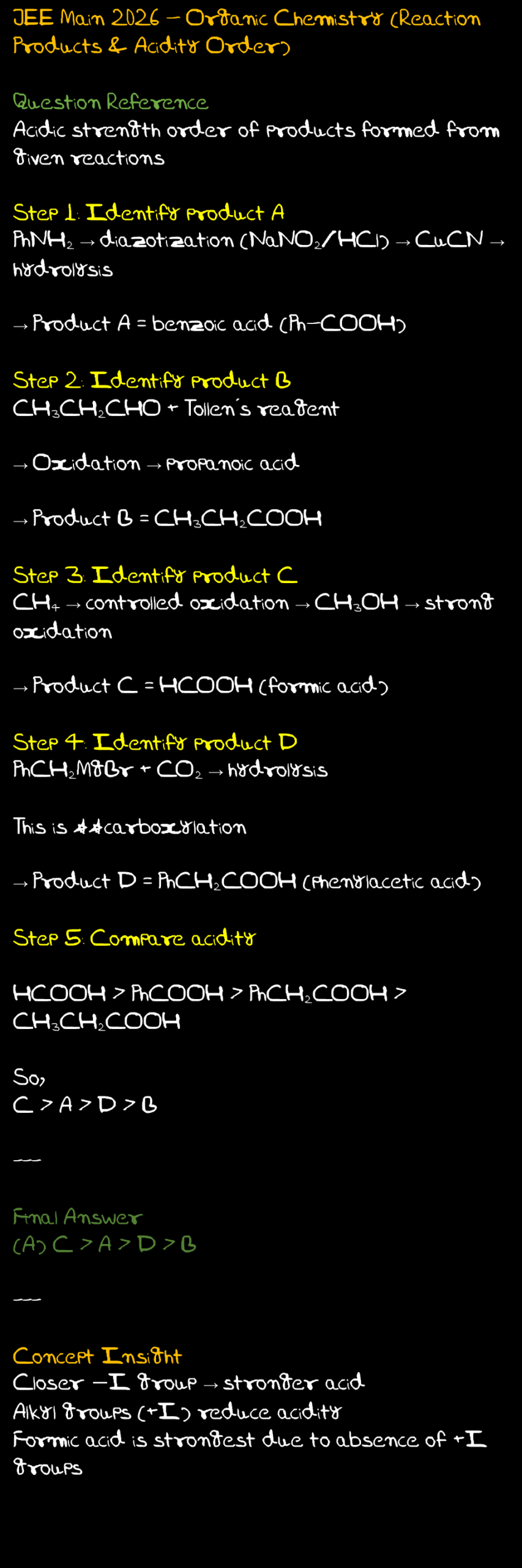
- PhCH2MgBr is benzyl magnesium bromide
- Reaction with CO2 followed by hydrolysis gives a carboxylic acid with one extra carbon
- So the product is phenylacetic acid
So D = phenylacetic acid (C6H5CH2COOH).
Step 5: Compare the Acidic Strength
- Formic acid is strongest because it has no electron-donating alkyl group
- Benzoic acid is next because the phenyl ring is directly attached to the carboxyl group
- Phenylacetic acid is less acidic than benzoic acid because the phenyl group is separated by CH2
- Propanoic acid is weakest because the ethyl group shows +I effect and decreases acidity
Hence the order is:
- C > A > D > B
Step 6: Write Final Answer
So the correct option is (A).
Final Answer
Option (A): C > A > D > B ✓
The correct order of acidic strength of the major products is C > A > D > B.
Essential Formulas for This Topic
Primary Rules
- Conjugate Base Stability Rule:
- Stronger acid gives more stable conjugate base
- Greater stabilization means easier H+ loss
- Acidity depends on substituent effects near COOH
- Inductive Effect Rule:
- Electron-withdrawing groups increase acidity
- Electron-donating alkyl groups decrease acidity
- +I effect destabilizes the carboxylate ion
- Distance Effect Rule:
- The closer the substituent to COOH, the stronger its effect
- Direct phenyl attachment affects acidity more than a phenyl group separated by CH2
- That is why benzoic acid is more acidic than phenylacetic acid
Important Constants
- Formic acid is more acidic than alkyl-substituted carboxylic acids
- Benzoic acid is more acidic than phenylacetic acid
- Phenylacetic acid is more acidic than propanoic acid
- Correct order here is HCOOH > C6H5COOH > C6H5CH2COOH > CH3CH2COOH
Common Mistakes to Avoid
❌ Mistake 1: Comparing Reactants Instead of Products
Wrong Thinking: “I can compare acidity directly from the starting compounds.”
Correct Approach: First identify A, B, C and D completely, then compare their acidic strength.
❌ Mistake 2: Confusing Benzoic Acid and Phenylacetic Acid
Wrong Approach: Treating both as almost same in acidity
Correct Approach: Benzoic acid has phenyl directly attached to COOH, while phenylacetic acid has a CH2 group in between.
❌ Mistake 3: Forgetting the +I Effect of Alkyl Groups
Common Error:
- Thinking propanoic acid should be stronger because it is a larger molecule
- Ignoring the electron-donating effect of alkyl groups
Correct Approach: Alkyl groups reduce acidity by destabilizing the conjugate base.
❌ Mistake 4: Missing the Product from Grignard Reagent
Wrong Thinking: “PhCH2MgBr + CO2 gives benzoic acid.”
Correct Understanding:
- CO2 insertion adds one carbon atom
- So the product is phenylacetic acid, not benzoic acid
- This changes the final acidity order
Key Concept Summary
What You Must Remember
- Always identify the final products first: Product recognition is the first step
- Formic acid is very strong among simple carboxylic acids: No alkyl group is attached
- Benzoic acid is more acidic than phenylacetic acid: Because the phenyl effect is stronger when directly attached
- Alkyl groups decrease acidity: Due to +I effect
- Product-based comparison is the key: Not reactant-based comparison
The Golden Rule for Acidity Order Questions
“First identify the products, then compare conjugate base stability.”
Frequently Asked Questions
Q1: Why is formic acid the strongest here?
A: Because it has no electron-donating alkyl group, so its conjugate base is relatively more stable.
Q2: Why is benzoic acid more acidic than phenylacetic acid?
A: Because in benzoic acid the phenyl ring is directly attached to the carboxyl group, so its effect is stronger than in phenylacetic acid where a CH2 group separates them.
Q3: Why is propanoic acid the weakest?
A: Because the ethyl group shows +I effect and destabilizes the carboxylate ion.
Q4: What is the product of benzyl magnesium bromide with CO2?
A: It forms phenylacetic acid after acidic hydrolysis.
Q5: What is the final acidity order?
A: C > A > D > B.
Prerequisites to Solve This Question
Before attempting this problem, you should understand:
- Diazotization and Sandmeyer reaction: Conversion of aniline to nitrile
- Hydrolysis of nitriles: Formation of carboxylic acids
- Oxidation of aldehydes: Tollens reagent reaction
- Grignard reaction with CO2: Carboxylation reaction
- Carboxylic acid acidity: Inductive effect and conjugate base stability
After Solving This, You Can:
✅ Identify products from multistep organic reactions confidently
✅ Compare acidity of carboxylic acids accurately
✅ Use inductive effect in acidity questions
✅ Distinguish benzoic acid and phenylacetic acid clearly
✅ Avoid common product-identification mistakes
✅ Solve JEE Main acidity order questions faster
Study Tips for This Topic
For JEE Main:
- Always decode the reactions first: Do not rush directly to the acidity order
- Memorize common product conversions: Diazonium to nitrile, nitrile to acid, aldehyde to acid, Grignard to acid
- Revise acidity trends: Formic acid > aromatic substituted acids > aliphatic acids
- Practice conjugate base logic: Stability decides acidic strength
Common JEE Variants:
- Acidic strength order of products formed in reactions
- Product identification followed by property comparison
- Benzoic acid vs aliphatic acid acidity questions
- Grignard plus CO2 based product questions
Difficulty Rating & Exam Frequency
Difficulty Level: ⭐⭐⭐ (3/5) – Medium
JEE Main Frequency: High – Product identification plus acidity comparison is a common pattern
JEE Advanced Frequency: Medium – Often combined with mechanism and property analysis
Topic Importance: Very High – Carboxylic acid acidity and reaction-based identification are core organic chemistry concepts
Written by Nishant Kumar
Chemistry Educator with 10+ Years of Experience Teaching JEE Aspirants
Founder – PadhoLikhoJEE
Last Updated: April 2026
Question Source: JEE Main 2026 PYQ
Topic: Aldehyde, Ketone and Carboxylic Acid – Acidic Strength of Major Products