
Order of Energy of Photons – Atomic Structure JEE PYQ
Quick Summary
Question Type: Energy comparison and calculation
Chapter: Atomic Structure – Electromagnetic Radiation
Difficulty: ⭐⭐⭐ Medium
Time to Solve: 2-3 minutes
Key Formula: E = hν (Energy-Frequency Relationship)
Correct Answer: (C) B > A > C
Why: Photon B has the highest frequency (10¹⁶ s⁻¹), therefore it has the highest energy since E ∝ ν
The Question
JEE Main – Atomic Structure
The wavelength of photon A is 400 nm.
The frequency of photon B is 10¹⁶ s⁻¹.
The wave number of photon C is 10⁴ cm⁻¹.
What is the correct order of energy of these photons?
(A) A > C > B
(B) C > B > A
(C) B > A > C ✓
(D) A > B > C
Quick Answer
Correct Option: (C) B > A > C
Reasoning: Photon energy is directly proportional to frequency (E = hν). After converting wavelength and wave number to frequency:
- Photon B has frequency = 10¹⁶ s⁻¹ (given directly)
- Photon A has frequency = 7.5 × 10¹⁴ s⁻¹ (calculated from λ = 400 nm)
- Photon C has frequency = 3 × 10¹² s⁻¹ (calculated from wave number)
Since νB > νA > νC, therefore EB > EA > EC
Video Solution
If you want the full explanation in a clear step-by-step teaching format, watch the video solution below:
Watch Full Video Solution on YouTube
Understanding the Concept
Why Energy Depends on Frequency
Photon energy is fundamentally determined by its frequency, not wavelength or wave number. This relationship was discovered by Max Planck and is expressed by the famous equation:
E = hν
Where:
- E = Energy of the photon
- h = Planck’s constant (6.626 × 10⁻³⁴ J·s)
- ν = Frequency of electromagnetic radiation
The Key Principle
To compare energies of different photons:
- Convert all given information (wavelength, frequency, or wave number) into frequency
- Higher frequency always means higher energy
- Compare the frequencies to determine energy order
Detailed Step-by-Step Solution
Step 1: Identify What’s Given
- Photon A: Wavelength (λ) = 400 nm = 400 × 10⁻⁹ m
- Photon B: Frequency (ν) = 10¹⁶ s⁻¹ (already in the form we need!)
- Photon C: Wave number (ν̄) = 10⁴ cm⁻¹ = 10⁶ m⁻¹
Step 2: Convert Everything to Frequency
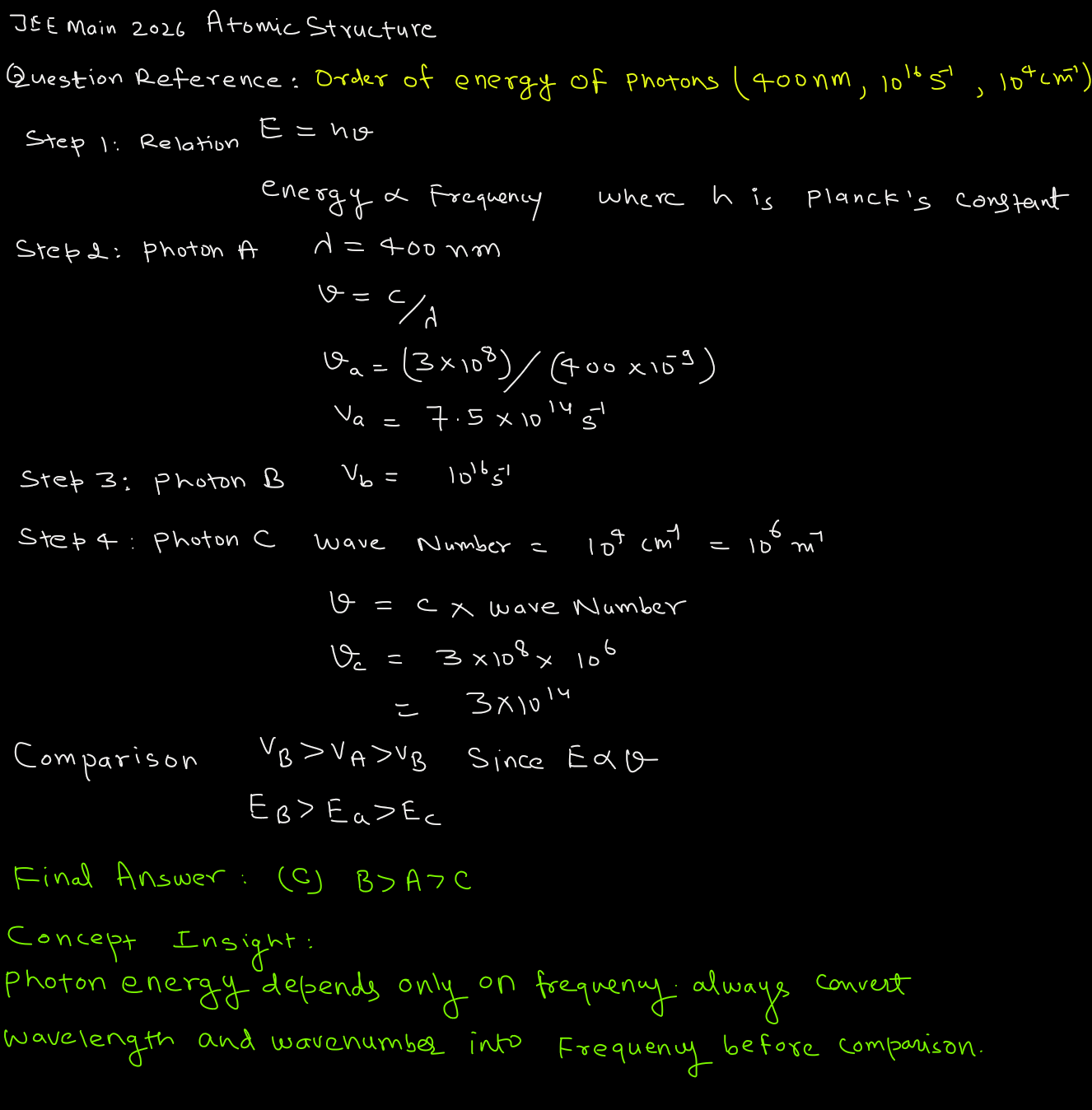
For Photon A (given wavelength):
- Use: c = νλ
- ν = c/λ = (3 × 10⁸ m/s) / (400 × 10⁻⁹ m)
- νA = 7.5 × 10¹⁴ s⁻¹
For Photon B (already given):
- νB = 10¹⁶ s⁻¹
For Photon C (given wave number):
- Use: ν = c × ν̄
- ν = (3 × 10⁸ m/s) × (10⁶ m⁻¹)
- νC = 3 × 10¹² s⁻¹
Step 3: Compare Frequencies
Arranging in descending order:
- νB = 10¹⁶ s⁻¹ (highest)
- νA = 7.5 × 10¹⁴ s⁻¹ (middle)
- νC = 3 × 10¹² s⁻¹ (lowest)
Step 4: Determine Energy Order
Since E = hν and h is constant:
- Higher frequency → Higher energy
- Therefore: EB > EA > EC
- Which gives us: B > A > C
Final Answer
Option (C): B > A > C ✓
Photon B has the maximum energy, followed by photon A, and photon C has the minimum energy among the three.
Essential Formulas for This Topic
Primary Equations
- Photon Energy:
- E = hν = hc/λ
- h = Planck’s constant = 6.626 × 10⁻³⁴ J·s
- c = Speed of light = 3 × 10⁸ m/s
- Wavelength-Frequency Relationship:
- c = νλ
- ν = c/λ
- λ = c/ν
- Wave Number Relationship:
- ν̄ = 1/λ (in same units)
- ν = c × ν̄
- E = hc × ν̄
Important Constants
- Planck’s constant (h) = 6.626 × 10⁻³⁴ J·s
- Speed of light (c) = 3 × 10⁸ m/s
- 1 nm = 10⁻⁹ m
- 1 cm⁻¹ = 10² m⁻¹
Common Mistakes to Avoid
❌ Mistake 1: Assuming Wavelength Directly Indicates Energy
Wrong Thinking: “Photon A has wavelength 400 nm, which is a small number, so it has low energy”
Correct Approach: Convert wavelength to frequency first using ν = c/λ, then determine energy. Smaller wavelength actually means HIGHER frequency and HIGHER energy.
❌ Mistake 2: Comparing Different Units Directly
Wrong Approach: Trying to compare 400 nm with 10¹⁶ s⁻¹ directly
Correct Approach: Convert all given parameters (wavelength, frequency, wave number) to the same parameter – preferably frequency – before comparing energies.
❌ Mistake 3: Unit Conversion Errors
Common Error:
- Forgetting to convert nm to m: 400 nm = 400 × 10⁻⁹ m (not 400 m)
- Forgetting to convert cm⁻¹ to m⁻¹: 10⁴ cm⁻¹ = 10⁶ m⁻¹
Correct Approach: Always work in SI units (meters, seconds) for consistency.
❌ Mistake 4: Confusing Inverse Relationships
Wrong Thinking: “Higher wavelength means higher energy”
Correct Understanding:
- Energy ∝ Frequency (direct relationship)
- Frequency ∝ 1/Wavelength (inverse relationship)
- Therefore: Energy ∝ 1/Wavelength (inverse relationship)
- Shorter wavelength = Higher energy
Key Concept Summary
What You Must Remember
- Photon energy depends ONLY on frequency: E = hν
- Higher frequency = Higher energy: This is a direct proportional relationship
- Shorter wavelength = Higher energy: This is an inverse relationship (λ ∝ 1/ν)
- Always convert to frequency first: When comparing different parameters
- Watch your units: nm to m, cm⁻¹ to m⁻¹
The Golden Rule for Energy Comparison
“Convert all given information to frequency, then compare. The highest frequency photon always has the highest energy.”
Frequently Asked Questions
Q1: How do you compare energies when given different parameters like wavelength, frequency, and wave number?
A: Convert all parameters to frequency using these relationships:
- From wavelength: ν = c/λ
- From wave number: ν = c × ν̄
- Then use E = hν to compare energies
Q2: Does a photon with shorter wavelength have more or less energy?
A: A photon with shorter wavelength has MORE energy. This is because wavelength and frequency are inversely related (c = νλ), and energy is directly proportional to frequency (E = hν).
Q3: What is the relationship between wave number and energy?
A: Energy is directly proportional to wave number: E = hc × ν̄. Higher wave number means higher energy because wave number is inversely proportional to wavelength (ν̄ = 1/λ).
Q4: Why do we use Planck’s constant in photon energy calculations?
A: Planck’s constant (h) connects the particle nature and wave nature of light. It’s the proportionality constant in the equation E = hν, discovered by Max Planck in 1900, which showed that energy is quantized.
Q5: In the visible spectrum, which color photon has the most energy?
A: Violet light has the most energy in the visible spectrum because it has the shortest wavelength (about 380-450 nm) and therefore the highest frequency. Red light has the least energy (longest wavelength, about 620-750 nm).
Prerequisites to Solve This Question
Before attempting this problem, you should understand:
- Basic wave properties: Wavelength, frequency, and their relationship
- Speed of light constant: c = 3 × 10⁸ m/s
- Planck’s equation: E = hν and its significance
- Unit conversions: nm to m, cm⁻¹ to m⁻¹
- Scientific notation: Working with powers of 10
After Solving This, You Can:
✅ Compare energies of any electromagnetic radiation
✅ Convert between wavelength, frequency, and wave number
✅ Apply Planck’s equation in different forms
✅ Solve JEE Main questions on photon energy confidently
✅ Understand the electromagnetic spectrum energy distribution
✅ Calculate actual energy values of photons when needed
Study Tips for This Topic
For JEE Main:
- Memorize key relationships: E = hν, c = νλ, ν̄ = 1/λ
- Practice unit conversions: Especially nm ↔ m and cm⁻¹ ↔ m⁻¹
- Understand inverse vs. direct relationships: Energy-frequency (direct), energy-wavelength (inverse)
- Time management: This question should take 2-3 minutes maximum
Common JEE Variants:
- Given energies, find wavelength order
- Given wavelengths, find frequency order
- Comparing photons from different regions of EM spectrum
- Numerical calculation of actual energy values
Difficulty Rating & Exam Frequency
Difficulty Level: ⭐⭐⭐ (3/5) – Medium
JEE Main Frequency: High – Appears 2-3 times per year
JEE Advanced Frequency: Medium – Usually combined with other concepts
Topic Importance: Very High – Fundamental to quantum mechanics
Written by Nishant Kumar
Chemistry Educator with 10+ Years of Experience Teaching JEE Aspirants
Founder – PadhoLikhoJEE
Last Updated: March 2026
Question Source: JEE Main Previous Year Questions
Topic: Atomic Structure – Electromagnetic Radiation & Photon Energy