
Chemical Equilibrium Concentration Shift Question JEE Main 2026
Quick Summary
Question Type: Equilibrium concentration shift calculation
Chapter: Chemical Equilibrium – Le Chatelier Principle and Kc
Difficulty: ⭐⭐⭐ Medium
Time to Solve: 3-5 minutes
Key Formula: Kc = [B]/[A] for A(g) ⇌ B(g)
Correct Answer: (D) 0.557, 0.418
Why: First calculate Kc from the initial equilibrium, then apply it again after adding 0.1 mol of A and shifting to the new equilibrium. This gives new concentrations of A = 0.557 M and B = 0.418 M.
The Question
JEE Main 2026 (28 January Evening Shift) – Chemical Equilibrium
Observe the following equilibrium in a 1 L flask.
A(g) ⇌ B(g)
At T(K), the equilibrium concentrations of A and B are 0.5 M and 0.375 M respectively. 0.1 moles of A is added into the flask and heated to T(K) to establish the equilibrium again. The new equilibrium concentrations (in M) of A and B are respectively.
(A) 0.742, 0.557
(B) 0.367, 0.275
(C) 0.53, 0.4
(D) 0.557, 0.418
Quick Answer
Correct Option: (D) 0.557, 0.418
Reasoning: At the first equilibrium:
- Kc = [B]/[A] = 0.375 / 0.5 = 0.75
After adding 0.1 mol of A in a 1 L flask:
- [A] becomes 0.6 M
- [B] remains 0.375 M initially
Let x M of A convert to B to re-establish equilibrium.
- New [A] = 0.6 – x
- New [B] = 0.375 + x
Apply Kc again:
- (0.375 + x) / (0.6 – x) = 0.75
- x = 0.043
So new equilibrium concentrations are:
- [A] = 0.557 M
- [B] = 0.418 M
Video Solution
If you want the full explanation in a clear step-by-step teaching format, watch the video solution below:
Watch Full Video Solution on YouTube
Understanding the Concept
Why Equilibrium Shifts After Adding More Reactant
When a reactant is added to a system already at equilibrium, the equilibrium gets disturbed. According to Le Chatelier’s principle, the system shifts in the forward direction to consume the added reactant and establish equilibrium again.
For the equilibrium:
A(g) ⇌ B(g)
The equilibrium constant at fixed temperature is:
Kc = [B]/[A]
Since temperature is unchanged, Kc remains constant. This lets us calculate the new equilibrium concentrations after the disturbance.
The Key Principle
- Find Kc from the original equilibrium data
- Add the extra reactant to get the new initial concentration
- Let the system shift by x and apply Kc again
Detailed Step-by-Step Solution
Step 1: Calculate the Equilibrium Constant
- Given initial equilibrium concentrations:
- [A] = 0.5 M
- [B] = 0.375 M
- For A(g) ⇌ B(g), Kc = [B]/[A]
- Kc = 0.375 / 0.5 = 0.75
Step 2: Add 0.1 mol of A to the Flask
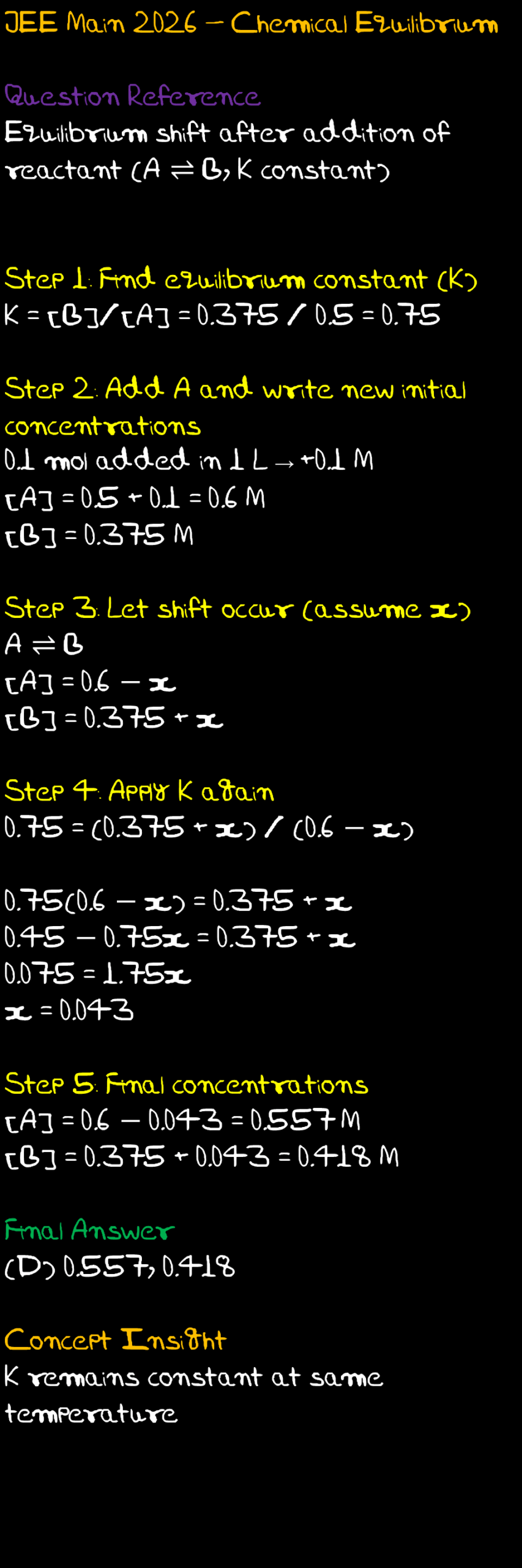
- The flask volume is 1 L
- So adding 0.1 mol A means concentration of A increases by 0.1 M
- New concentration before shift:
- [A] = 0.5 + 0.1 = 0.6 M
- [B] = 0.375 M
Step 3: Let the Equilibrium Re-establish
Let x M of A convert into B.
- [A] at new equilibrium = 0.6 – x
- [B] at new equilibrium = 0.375 + x
Step 4: Apply Kc Again
- Kc = [B]/[A] = 0.75
- (0.375 + x) / (0.6 – x) = 0.75
Solving:
- 0.375 + x = 0.45 – 0.75x
- 1.75x = 0.075
- x = 0.043
Step 5: Find the New Equilibrium Concentrations
- [A] = 0.6 – 0.043 = 0.557 M
- [B] = 0.375 + 0.043 = 0.418 M
Final Answer
Option (D): 0.557, 0.418 ✓
The new equilibrium concentrations are [A] = 0.557 M and [B] = 0.418 M.
Essential Formulas for This Topic
Primary Equations
- Equilibrium Constant Expression:
- For A(g) ⇌ B(g), Kc = [B]/[A]
- At fixed temperature, Kc remains constant
- Used before and after disturbance
- Concentration Change in 1 L Flask:
- 1 mole in 1 L = 1 M
- 0.1 mole in 1 L = 0.1 M
- This makes the calculation direct
- ICE-Type Setup:
- Initial after disturbance: [A] = 0.6, [B] = 0.375
- Change: -x, +x
- Equilibrium: 0.6 – x, 0.375 + x
Important Constants
- Temperature is constant, so Kc does not change
- Le Chatelier’s principle predicts forward shift when reactant is added
- In a 1 L flask, moles added directly equal concentration change
- Equilibrium is re-established after the disturbance
Common Mistakes to Avoid
❌ Mistake 1: Recalculating Kc Incorrectly
Wrong Thinking: “Adding A changes Kc.”
Correct Approach: Kc depends only on temperature. Since temperature remains T(K), Kc stays constant.
❌ Mistake 2: Forgetting the 1 L Flask Simplification
Wrong Approach: Converting moles to concentration unnecessarily in a complicated way
Correct Approach: In a 1 L flask, 0.1 mole directly means 0.1 M.
❌ Mistake 3: Taking the Shift in the Wrong Direction
Common Error:
- Writing [A] = 0.6 + x
- Writing [B] = 0.375 – x
Correct Approach: Since more reactant A is added, equilibrium shifts forward, so A decreases by x and B increases by x.
❌ Mistake 4: Choosing the Option Closest to Old Equilibrium
Wrong Thinking: “Since change is small, any nearby option is fine.”
Correct Understanding:
- Use the exact Kc calculation
- The new equilibrium must satisfy the same Kc
- The correct concentrations are 0.557 and 0.418
Key Concept Summary
What You Must Remember
- Kc remains constant at fixed temperature: It does not change when concentration changes
- Added reactant shifts equilibrium forward: The system opposes the disturbance
- In a 1 L flask, mole change equals molarity change: Very useful shortcut
- Use x method carefully: Set new equilibrium concentrations before applying Kc
- Always check direction of shift: Reactant added means product formation increases
The Golden Rule for Equilibrium Disturbance Questions
“Find Kc first, apply the disturbance, then re-establish equilibrium using the same Kc.”
Frequently Asked Questions
Q1: Why does Kc remain the same after adding A?
A: Because equilibrium constant depends only on temperature, and the temperature remains unchanged.
Q2: Why does the equilibrium shift forward after adding A?
A: According to Le Chatelier’s principle, the system shifts to consume the added reactant.
Q3: Why is 0.1 mole equal to 0.1 M here?
A: Because the flask volume is 1 L, so concentration change equals moles added per liter.
Q4: How do we set the new equilibrium concentrations?
A: After adding A, take [A] = 0.6 – x and [B] = 0.375 + x before applying Kc.
Q5: What are the final new equilibrium concentrations?
A: The new equilibrium concentrations are 0.557 M and 0.418 M.
Prerequisites to Solve This Question
Before attempting this problem, you should understand:
- Chemical equilibrium: Meaning of equilibrium constant
- Le Chatelier’s principle: Effect of adding reactant or product
- Kc expression: Writing equilibrium constant correctly
- Basic algebra: Solving one-variable equilibrium equations
- Concentration concept: Mole to molarity relation in 1 L flask
After Solving This, You Can:
✅ Calculate new equilibrium concentrations after disturbance
✅ Use Kc correctly at constant temperature
✅ Apply Le Chatelier’s principle quantitatively
✅ Solve 1 L flask equilibrium questions quickly
✅ Avoid common direction-of-shift mistakes
✅ Handle similar JEE Main Chemical Equilibrium PYQs confidently
Study Tips for This Topic
For JEE Main:
- Always find Kc first: It simplifies the whole problem
- Use 1 L shortcut carefully: Mole added equals molarity change
- Track the shift direction: Added reactant pushes equilibrium forward
- Practice x-based equilibrium problems: They are very common in JEE Main
Common JEE Variants:
- New equilibrium after adding reactant
- New equilibrium after removing product
- Kc-based concentration calculation
- Le Chatelier principle with numerical equilibrium shift
Difficulty Rating & Exam Frequency
Difficulty Level: ⭐⭐⭐ (3/5) – Medium
JEE Main Frequency: High – Equilibrium shift numericals are common
JEE Advanced Frequency: Medium – Usually asked with more algebraic depth
Topic Importance: Very High – Kc and Le Chatelier principle are core concepts in Chemical Equilibrium
Written by Nishant Kumar
Chemistry Educator with 10+ Years of Experience Teaching JEE Aspirants
Founder – PadhoLikhoJEE
Last Updated: March 2026
Question Source: JEE Main 2026 PYQ
Topic: Chemical Equilibrium – Le Chatelier Principle and Kc