
Coordination Chemistry Magnetic Moment Order Question JEE Main 2026
Quick Summary
Question Type: Spin-only magnetic moment comparison of coordination compounds
Chapter: Coordination Chemistry – Magnetic Properties of Complexes
Difficulty: ⭐⭐ Easy
Time to Solve: 3-4 minutes
Key Formula: μ = √[n(n + 2)] BM
Correct Answer: (C) C < B < D < A
Why: [Ni(CN)₄]²⁻ is diamagnetic, [Cu(H₂O)₆]²⁺ has 1 unpaired electron, [Ni(H₂O)₆]²⁺ has 2 unpaired electrons, and [MnBr₄]²⁻ has 5 unpaired electrons. Therefore, the increasing order is C < B < D < A.
The Question
JEE Main 2026 (28 January Evening Shift) – Coordination Chemistry
The correct increasing order of spin-only magnetic moment values of the complex ions
[MnBr4]2- (A), [Cu(H2O)6]2+ (B), [Ni(CN)4]2- (C) and [Ni(H2O)6]2+ (D) is:
(A) A = B < D < C
(B) C = D < B < A
(C) C < B < D < A
(D) A = B < C < D
Quick Answer
Correct Option: (C) C < B < D < A
Reasoning: Spin-only magnetic moment depends on the number of unpaired electrons.
- [Ni(CN)4]2- is square planar and diamagnetic → 0 unpaired electrons
- [Cu(H2O)6]2+ has 1 unpaired electron
- [Ni(H2O)6]2+ has 2 unpaired electrons
- [MnBr4]2- has 5 unpaired electrons
So the increasing order of magnetic moment is:
C < B < D < A
Video Solution
If you want the full explanation in a clear step-by-step teaching format, watch the video solution below:
Watch Full Video Solution on YouTube
Understanding the Concept
Why Magnetic Moment Depends on Unpaired Electrons
The spin-only magnetic moment of a coordination compound depends only on the number of unpaired electrons present in the d-orbitals of the metal ion.
μ = √[n(n + 2)] BM
Where:
- μ = magnetic moment in Bohr Magneton (BM)
- n = number of unpaired electrons
So to compare magnetic moments, we only need to find the number of unpaired electrons in each complex.
The Key Principle
- Find oxidation state of the metal ion
- Write its d-electron configuration
- Check ligand strength and geometry
- Count unpaired electrons
- More unpaired electrons means higher magnetic moment
Detailed Step-by-Step Solution
Step 1: Recall the Spin-Only Formula
- μ = √[n(n + 2)] BM
- Magnetic moment increases with the number of unpaired electrons
- So we compare complexes by counting unpaired electrons
Step 2: Analyze Each Complex
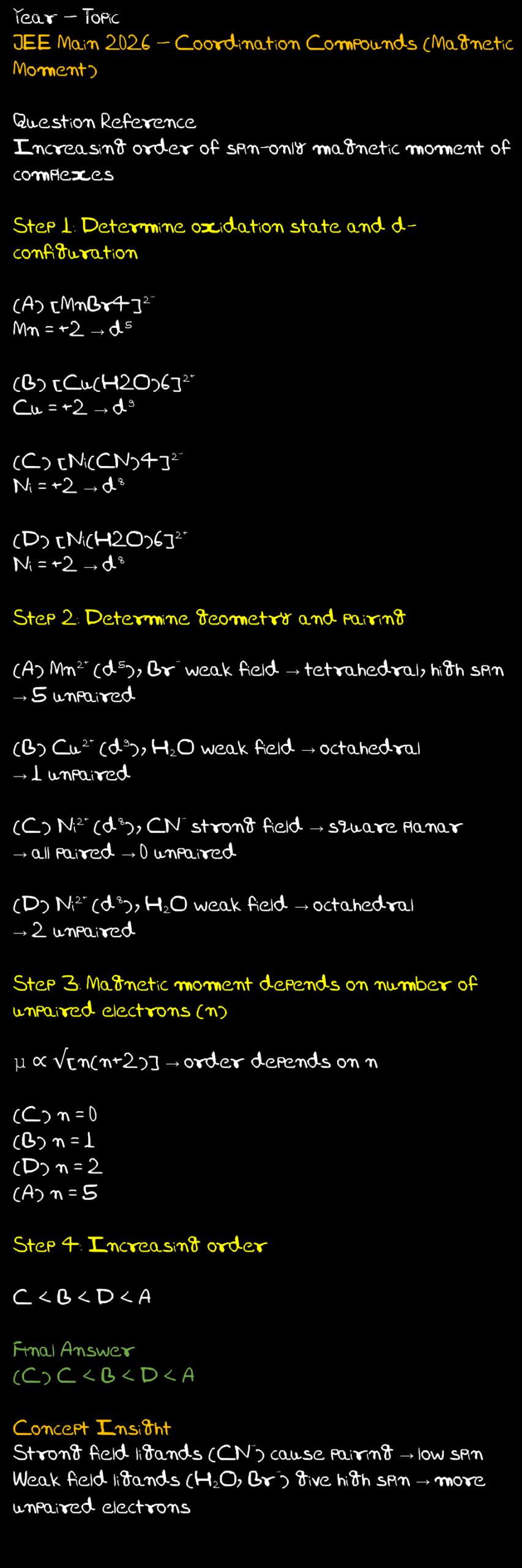
(A) [MnBr4]2-
- Oxidation state of Mn = +2
- Mn²⁺ = 3d5
- Br⁻ is a weak field ligand
- Tetrahedral complex remains high spin
- Unpaired electrons = 5
(B) [Cu(H2O)6]2+
- Oxidation state of Cu = +2
- Cu²⁺ = 3d9
- Unpaired electrons = 1
(C) [Ni(CN)4]2-
- Oxidation state of Ni = +2
- Ni²⁺ = 3d8
- CN⁻ is a strong field ligand
- Complex becomes square planar
- All electrons are paired
- Unpaired electrons = 0
(D) [Ni(H2O)6]2+
- Oxidation state of Ni = +2
- Ni²⁺ = 3d8
- H₂O is a weak field ligand
- Octahedral high-spin arrangement
- Unpaired electrons = 2
Step 3: Compare Number of Unpaired Electrons
- C → 0 unpaired electrons
- B → 1 unpaired electron
- D → 2 unpaired electrons
- A → 5 unpaired electrons
Step 4: Write the Magnetic Moment Order
Since magnetic moment increases with unpaired electrons:
C < B < D < A
Final Answer
Option (C): C < B < D < A ✓
The correct increasing order of spin-only magnetic moment values is [Ni(CN)4]2- < [Cu(H2O)6]2+ < [Ni(H2O)6]2+ < [MnBr4]2-.
Essential Formulas for This Topic
Primary Equations
- Spin-Only Magnetic Moment:
- μ = √[n(n + 2)] BM
- n = number of unpaired electrons
- Used for quick JEE magnetic property questions
- d-Electron Counting Rule:
- Find oxidation state first
- Then determine d-electron configuration of the metal ion
- Ligand strength affects pairing
- Ligand Strength Logic:
- CN⁻ is strong field
- H₂O and Br⁻ are weak field ligands
- Strong field ligands promote pairing
Important Constants
- More unpaired electrons means larger magnetic moment
- Square planar d8 complexes are often diamagnetic
- Tetrahedral complexes are generally high spin
- Weak field ligands usually do not cause pairing
Common Mistakes to Avoid
❌ Mistake 1: Ignoring Ligand Strength
Wrong Thinking: “All Ni²⁺ complexes must have the same magnetic behavior.”
Correct Approach: Ligand strength changes electron pairing. [Ni(CN)4]2- and [Ni(H2O)6]2+ behave differently because CN⁻ is strong field and H₂O is weak field.
❌ Mistake 2: Forgetting Geometry
Wrong Approach: Not checking whether the complex is tetrahedral, octahedral, or square planar
Correct Approach: Geometry strongly affects splitting and pairing, especially in d8 complexes.
❌ Mistake 3: Miscounting d-Electrons
Common Error:
- Taking Ni²⁺ as d6 or Cu²⁺ as d8
- Ignoring oxidation state before writing configuration
Correct Approach: Always determine oxidation state first, then write the correct d-electron count.
❌ Mistake 4: Thinking Diamagnetic Means Small but Nonzero Moment
Wrong Thinking: “Diamagnetic complexes still have some spin-only moment.”
Correct Understanding:
- Diamagnetic means all electrons are paired
- So n = 0
- Hence spin-only magnetic moment is zero
- That is why C is the lowest in the order
Key Concept Summary
What You Must Remember
- Magnetic moment depends on unpaired electrons: More unpaired electrons means larger μ
- Find oxidation state first: Then write d-electron configuration
- Ligand strength matters: CN⁻ pairs electrons, H₂O and Br⁻ usually do not
- Geometry matters too: Square planar d8 is often diamagnetic
- Count carefully: C has 0, B has 1, D has 2, A has 5 unpaired electrons
The Golden Rule for Magnetic Moment Questions
“Find oxidation state, d-electron count, ligand strength, and geometry before comparing unpaired electrons.”
Frequently Asked Questions
Q1: Why is [Ni(CN)4]2- diamagnetic?
A: Because CN⁻ is a strong field ligand and the complex becomes square planar, causing all electrons to pair.
Q2: Why does [MnBr4]2- have the highest magnetic moment?
A: Mn²⁺ is d5 and Br⁻ is a weak field ligand, so all five electrons remain unpaired.
Q3: Why is [Cu(H2O)6]2+ not diamagnetic?
A: Cu²⁺ is d9, so one electron remains unpaired.
Q4: Why is [Ni(H2O)6]2+ more magnetic than [Cu(H2O)6]2+?
A: Because [Ni(H2O)6]2+ has 2 unpaired electrons, while [Cu(H2O)6]2+ has only 1.
Q5: What is the final increasing order of magnetic moment?
A: C < B < D < A.
Prerequisites to Solve This Question
Before attempting this problem, you should understand:
- Oxidation state: Determining metal ion charge in complexes
- d-Block configurations: Writing d-electron count of metal ions
- Crystal field theory basics: Strong field and weak field ligands
- Coordination geometry: Tetrahedral, octahedral and square planar complexes
- Magnetic behavior: Difference between paramagnetic and diamagnetic complexes
After Solving This, You Can:
✅ Compare spin-only magnetic moments confidently
✅ Count unpaired electrons in coordination compounds
✅ Use ligand strength to predict pairing
✅ Distinguish diamagnetic and paramagnetic complexes
✅ Solve JEE Main coordination compound magnetic questions faster
✅ Apply the same logic to more advanced crystal field problems
Study Tips for This Topic
For JEE Main:
- Memorize strong and weak field ligands: This helps immediately in pairing decisions
- Practice oxidation state calculation: Wrong oxidation state ruins the whole question
- Remember common special cases: Square planar d8 complexes are very important
- Use unpaired electron count directly: It is enough for spin-only moment order questions
Common JEE Variants:
- Increasing or decreasing magnetic moment order
- Find diamagnetic complex
- Find number of unpaired electrons
- Compare strong field and weak field complexes
Difficulty Rating & Exam Frequency
Difficulty Level: ⭐⭐ (2/5) – Easy
JEE Main Frequency: High – Magnetic property questions are common in Coordination Chemistry
JEE Advanced Frequency: Medium – Often combined with CFT and geometry concepts
Topic Importance: Very High – Magnetic behavior is a core part of coordination chemistry
Written by Nishant Kumar
Chemistry Educator with 10+ Years of Experience Teaching JEE Aspirants
Founder – PadhoLikhoJEE
Last Updated: March 2026
Question Source: JEE Main 2026 PYQ
Topic: Coordination Chemistry – Magnetic Properties of Complexes
“`