
Increasing Order of Boiling Point of Aqueous Solutions – Solutions JEE Main 2026 PYQ
Quick Summary
Question Type: Colligative properties and boiling point elevation comparison
Chapter: Solutions – Elevation in Boiling Point
Difficulty: ⭐⭐ Easy
Time to Solve: 2-3 minutes
Key Formula: ΔTb = iKbm
Correct Answer: (D) I < II < III < IV
Why: Boiling point elevation depends on i × m. Comparing effective particle concentration for all four solutions gives the increasing order I < II < III < IV.
The Question
JEE Main 2026 (28 January Evening Shift) – Solutions
Consider the following aqueous solutions.
I. 2.2 g Glucose in 125 mL of solution.
II. 1.9 g Calcium chloride in 250 mL of solution.
III. 9.0 g Urea in 500 mL of solution.
IV. 20.5 g Aluminium sulphate in 750 mL of solution.
The correct increasing order of boiling point of these solutions will be:
Given: Molar mass in g mol-1 : H = 1, C = 12, N = 14, O = 16, Cl = 35.5, Ca = 40, Al = 27 and S = 32
(A) III < I < II < IV
(B) II < III < IV < I
(C) II < III < I < IV
(D) I < II < III < IV
Quick Answer
Correct Option: (D) I < II < III < IV
Reasoning: For dilute aqueous solutions, boiling point elevation depends on:
- ΔTb ∝ i × m
- Glucose and urea are non-electrolytes, so i = 1
- CaCl2 dissociates into 3 ions, so i = 3
- Al2(SO4)3 dissociates into 5 ions, so i = 5
Comparing effective particle concentration shows:
I < II < III < IV
Video Solution
If you want the full explanation in a clear step-by-step teaching format, watch the video solution below:
Watch Full Video Solution on YouTube
Understanding the Concept
Why Boiling Point Depends on Number of Solute Particles
Elevation in boiling point is a colligative property. It depends not on the chemical nature of the solute, but on the number of solute particles present in the solution.
ΔTb = iKbm
Where:
- ΔTb = elevation in boiling point
- i = van’t Hoff factor
- Kb = ebullioscopic constant of solvent
- m = molality of solution
The Key Principle
To compare boiling points:
- Calculate moles of solute
- Estimate concentration from the given solution volume
- Multiply by van’t Hoff factor i for electrolytes
- Higher effective particle concentration means higher boiling point
Detailed Step-by-Step Solution
Step 1: Use the Boiling Point Relation
- Boiling point elevation follows ΔTb = iKbm
- Since the solvent is the same, Kb is common for all
- So we only need to compare i × concentration
Step 2: Calculate for Each Solution
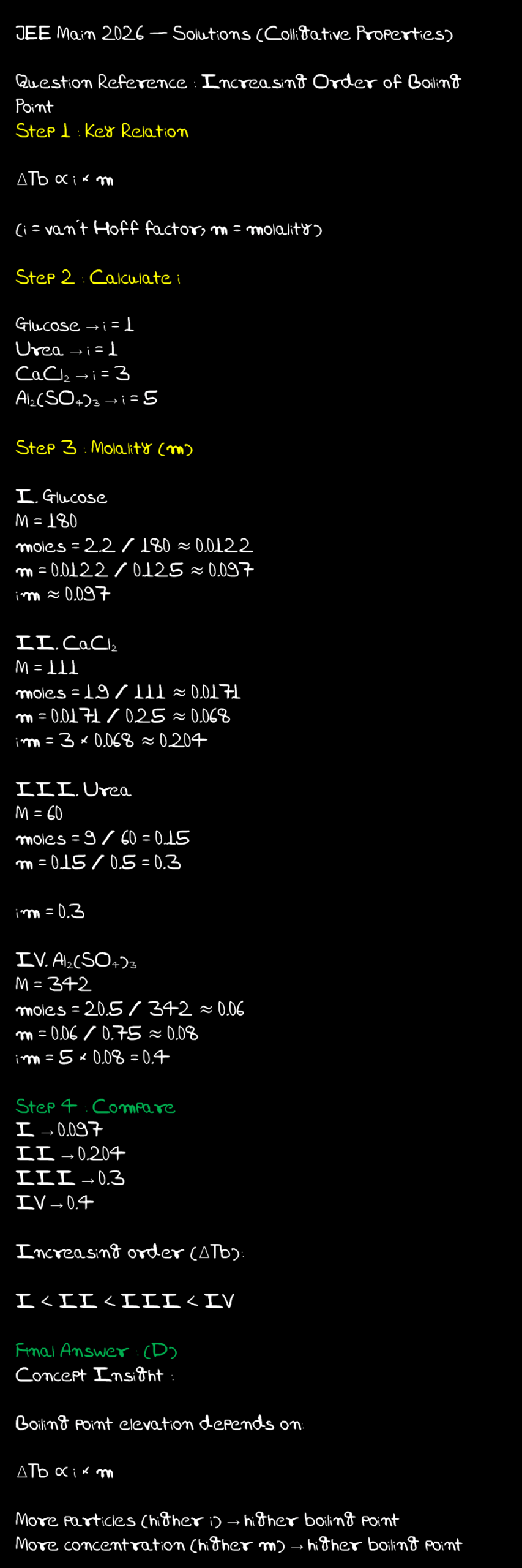
Solution I: Glucose
- Molar mass of glucose = 180 g mol-1
- Moles = 2.2 / 180
- Non-electrolyte, so i = 1
- Effective particle concentration is the lowest
Solution II: Calcium chloride
- Molar mass of CaCl2 = 40 + 2 × 35.5 = 111 g mol-1
- Moles = 1.9 / 111
- CaCl2 dissociates into 3 ions, so i = 3
Solution III: Urea
- Molar mass of urea = 60 g mol-1
- Moles = 9.0 / 60 = 0.15
- Non-electrolyte, so i = 1
Solution IV: Aluminium sulphate
- Molar mass of Al2(SO4)3 = 2 × 27 + 3 × (32 + 4 × 16) = 342 g mol-1
- Moles = 20.5 / 342
- Al2(SO4)3 dissociates into 5 ions, so i = 5
Step 3: Compare Effective Particle Concentration
On comparing i × concentration for all four:
- I has the least value
- II is greater than I
- III is greater than II
- IV is the highest
Step 4: Write the Increasing Order of Boiling Point
Since boiling point increases with ΔTb:
- I < II < III < IV
So the correct option is:
- (D)
Final Answer
Option (D): I < II < III < IV ✓
The increasing order of boiling point is Glucose solution < Calcium chloride solution < Urea solution < Aluminium sulphate solution.
Essential Formulas for This Topic
Primary Equations
- Elevation in Boiling Point:
- ΔTb = iKbm
- Boiling point increases with number of solute particles
- For the same solvent, compare i × m
- Moles of Solute:
- Moles = mass / molar mass
- Needed to compare concentration
- Used for both electrolytes and non-electrolytes
- van’t Hoff Factor:
- Glucose: i = 1
- Urea: i = 1
- CaCl2: i = 3
- Al2(SO4)3: i = 5
Important Constants
- Glucose and urea are non-electrolytes
- Electrolytes increase particle count after dissociation
- Boiling point elevation is a colligative property
- Higher effective particle concentration means higher boiling point
Common Mistakes to Avoid
❌ Mistake 1: Comparing Only Mass of Solute
Wrong Thinking: “Higher mass means higher boiling point.”
Correct Approach: Boiling point depends on number of particles, not directly on mass. Always convert to moles and include dissociation.
❌ Mistake 2: Ignoring van’t Hoff Factor
Wrong Approach: Treating CaCl2 and Al2(SO4)3 like non-electrolytes
Correct Approach: Electrolytes dissociate in solution, so multiply by i while comparing boiling point elevation.
❌ Mistake 3: Missing the Effect of Volume
Common Error:
- Comparing only moles of solute
- Ignoring that solution volumes are different
Correct Approach: Concentration comparison requires attention to the amount of solvent or solution volume given.
❌ Mistake 4: Confusing Increasing and Decreasing Order
Wrong Thinking: “IV should come first, so it must be the answer order directly.”
Correct Understanding:
- The question asks for increasing order
- So start with the lowest boiling point
- Write the sequence from smallest to greatest
- That gives I < II < III < IV
Key Concept Summary
What You Must Remember
- Boiling point elevation is colligative: It depends on the number of particles
- Use ΔTb = iKbm: Compare i × m for the same solvent
- Electrolytes matter more: Dissociation increases particle count
- Always calculate moles correctly: Mass alone is not enough
- Read the order carefully: Increasing order means lowest to highest
The Golden Rule for Boiling Point Order Questions
“For the same solvent, the solution with larger i × concentration has higher boiling point.”
Frequently Asked Questions
Q1: Why does boiling point elevation depend on i × m?
A: Because boiling point elevation is a colligative property, so it depends on the number of dissolved particles present in the solution.
Q2: Why is glucose lower than calcium chloride here?
A: Glucose does not dissociate, but calcium chloride produces three ions in solution, increasing the effective particle concentration.
Q3: Why is aluminium sulphate highest in the order?
A: Aluminium sulphate dissociates into five ions and gives the greatest effective particle concentration among the given solutions.
Q4: Do we always need exact molality in such questions?
A: Not always. For comparison questions, a proportional comparison of i × concentration is often enough.
Q5: What is the final increasing order of boiling point here?
A: I < II < III < IV.
Prerequisites to Solve This Question
Before attempting this problem, you should understand:
- Colligative properties: Especially boiling point elevation
- Mole concept: Converting mass into moles
- Dissociation of electrolytes: van’t Hoff factor idea
- Basic concentration comparison: Relating moles to volume
- Reading order questions carefully: Increasing vs decreasing order
After Solving This, You Can:
✅ Compare boiling points of different solutions confidently
✅ Use van’t Hoff factor in colligative property questions
✅ Convert given mass data into useful mole comparison
✅ Solve JEE Main Solutions chapter questions faster
✅ Avoid common mistakes in boiling point order problems
✅ Apply the same logic to freezing point and osmotic pressure questions
Study Tips for This Topic
For JEE Main:
- Memorize the formula: ΔTb = iKbm
- Focus on particle count: That is the heart of colligative properties
- Practice electrolyte vs non-electrolyte comparison: It saves time in MCQs
- Watch units and order carefully: Many mistakes happen in comparison questions
Common JEE Variants:
- Increasing order of boiling point
- Increasing order of freezing point depression
- Comparison of osmotic pressure
- Electrolyte vs non-electrolyte colligative property questions
Difficulty Rating & Exam Frequency
Difficulty Level: ⭐⭐ (2/5) – Easy
JEE Main Frequency: High – Colligative property comparisons are common
JEE Advanced Frequency: Medium – Often combined with dissociation or association concepts
Topic Importance: Very High – Solutions chapter frequently tests colligative properties
Written by Nishant Kumar
Chemistry Educator with 10+ Years of Experience Teaching JEE Aspirants
Founder – PadhoLikhoJEE
Last Updated: March 2026
Question Source: JEE Main 2026 PYQ
Topic: Solutions – Elevation in Boiling Point