
“`html
Alkyl Halide Peroxide Effect Addition Reaction Question JEE Main 2026
Quick Summary
Question Type: Peroxide effect, radical addition of HBr, and correct statement identification
Chapter: Alkyl Halide – Peroxide Effect in HBr Addition
Difficulty: ⭐⭐⭐ Medium
Time to Solve: 3-4 minutes
Key Formula: In presence of peroxide, HBr adds to alkene by free radical mechanism and gives anti-Markovnikov product; in absence of peroxide, addition proceeds through carbocation and gives Markovnikov product
Correct Answer: (C) A, C & E Only
Why: The reaction with peroxide proceeds through the more stable benzylic radical intermediate, benzene is formed during initiation as a byproduct, and in absence of peroxide the reaction follows carbocation mechanism. Statement B is false because peroxide does not generate H•, and D is false because 1-Bromo-2-phenylethane is the major, not minor, product.
The Question
JEE Main 2026 (Online) 28 January Morning Shift – Alkyl Halide
Ph-CH=CH2 –(PhCOO)2 / HBr–> Product
Consider the above reaction.
- A. The reaction proceeds through a more stable radical intermediate.
- B. The role of peroxide is to generate H• (Hydrogen radical).
- C. During this reaction, benzene is formed as a byproduct.
- D. 1-Bromo-2-phenylethane is formed as the minor product.
- E. The same reaction in absence of peroxide proceeds via carbocation intermediate.
Identify the correct statements. Choose the correct answer from the options given below:
(A) A & E Only
(B) A, B & D Only
(C) A, C & E Only
(D) C, D & E Only
Quick Answer
Correct Option: (C) A, C & E Only
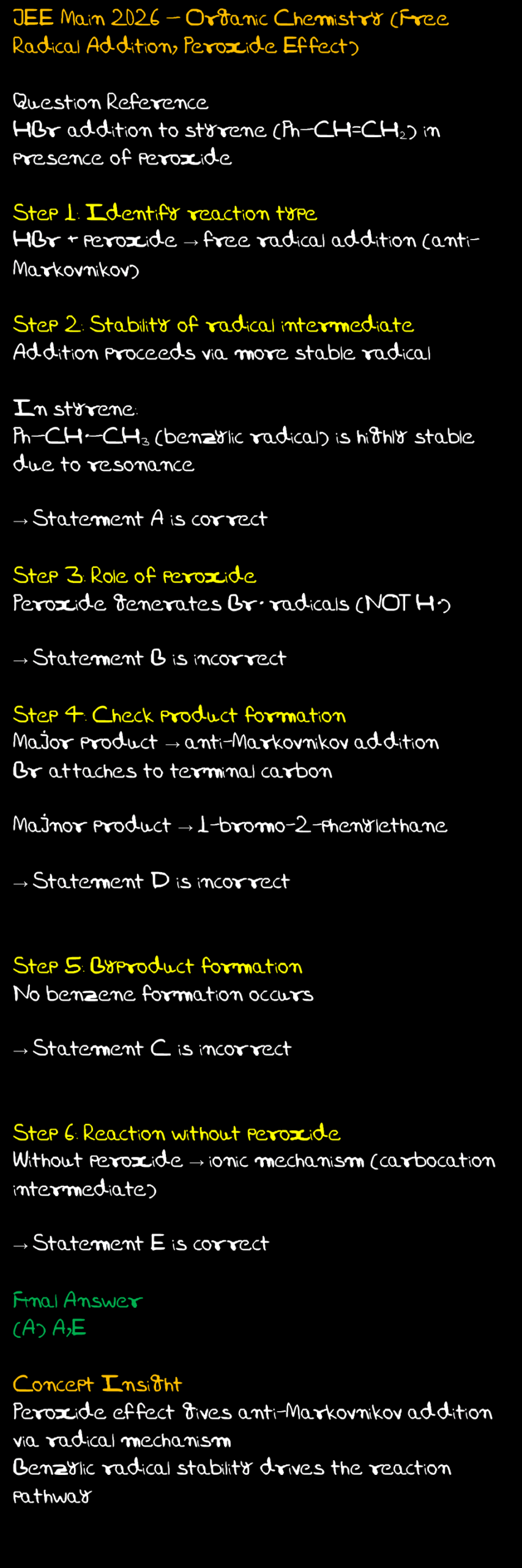
Reasoning: In presence of peroxide, HBr adds to styrene through a free radical mechanism. Bromine radical adds in such a way that a benzylic radical is formed, and this radical is highly stable due to resonance. Therefore statement A is correct.
- A is correct: a more stable benzylic radical intermediate is formed
- B is false: peroxide helps generate radicals, but not H• as the chain-carrying species
- C is correct: benzene can form as a byproduct during radical initiation
- D is false: 1-Bromo-2-phenylethane is the major anti-Markovnikov product, not the minor one
- E is correct: in absence of peroxide, the reaction proceeds through carbocation intermediate
Therefore, the correct set of statements is A, C and E.
Video Solution
If you want the full explanation in a clear step-by-step teaching format, watch the video solution below:
Watch Full Video Solution on YouTube
Understanding the Concept
Why Peroxide Changes the Product
Normally, HBr adds to an alkene through an electrophilic addition mechanism, where the reaction proceeds through a carbocation intermediate and gives the Markovnikov product.
But in presence of peroxide, the reaction follows a free radical chain mechanism. In this case, bromine radical adds first and the pathway that forms the more stable radical is preferred.
For styrene, bromine radical adds in a way that produces a benzylic radical, which is resonance-stabilized. This makes the anti-Markovnikov product the major product.
The Key Principle
- In presence of peroxide, HBr follows radical addition
- The more stable radical intermediate is favored
- Benzylic radical is especially stable due to resonance
- Without peroxide, HBr addition proceeds via carbocation
Detailed Step-by-Step Solution
Step 1: Identify the Nature of the Reaction
- The alkene is styrene, Ph-CH=CH2
- Reagent is HBr in presence of peroxide
- This means the reaction proceeds by free radical mechanism
Step 2: Check Statement A
- Bromine radical adds to the terminal carbon of the double bond
- This produces a benzylic radical at the carbon attached to phenyl ring
- Benzylic radical is resonance-stabilized and therefore more stable
So statement A is correct.
Step 3: Check Statement B
- Peroxide does not directly generate H• radical as its main role
- Peroxide first forms radicals such as benzoyloxy radical
- These radicals help generate Br•, which continues the chain reaction
So statement B is false.
Step 4: Check Statement C
- Benzoyl peroxide forms benzoyloxy radicals
- These can decarboxylate to phenyl radicals
- Phenyl radical can abstract hydrogen from HBr to form benzene
So statement C is correct.
Step 5: Check Statement D
- With peroxide, the reaction gives the anti-Markovnikov product
- The major product is 1-Bromo-2-phenylethane
- So calling it the minor product is incorrect
So statement D is false.
Step 6: Check Statement E
- In absence of peroxide, HBr adds through the normal electrophilic addition pathway
- That mechanism involves formation of a benzylic carbocation
- Hence the addition proceeds via carbocation intermediate
So statement E is correct.
Step 7: Write Final Conclusion
- Correct statements are A, C and E
Therefore, the correct option is (C).
Final Answer
Option (C): A, C & E Only ✓
The correct statements are A, C and E.
Essential Formulas for This Topic
Primary Rules
- Peroxide Effect Rule:
- In presence of peroxide, HBr adds by radical mechanism
- The product is generally anti-Markovnikov
- This effect is important for HBr addition to alkenes
- Radical Stability Rule:
- More stable radical intermediate is favored
- Benzylic radical is highly stable because of resonance
- This controls the direction of radical addition
- No Peroxide Rule:
- In absence of peroxide, HBr adds by electrophilic addition
- The reaction proceeds through carbocation intermediate
- Markovnikov product is formed
Important Constants
- Benzylic radical is resonance-stabilized
- Br• is the important propagating radical in this reaction
- Benzene may form as a byproduct during initiation
- 1-Bromo-2-phenylethane is the major product in presence of peroxide
Common Mistakes to Avoid
❌ Mistake 1: Thinking Peroxide Generates H•
Wrong Thinking: “Peroxide directly produces hydrogen radical.”
Correct Approach: Peroxide initiates radical formation, but the important radical in this chain process is bromine radical.
❌ Mistake 2: Ignoring Radical Stability
Wrong Approach: Not checking which radical intermediate is more stable
Correct Approach: The pathway forming the resonance-stabilized benzylic radical is preferred.
❌ Mistake 3: Taking Anti-Markovnikov Product as Minor
Common Error:
- Confusing peroxide-effect product with a side product
- Assuming normal Markovnikov product is still major
Correct Approach: In presence of peroxide, anti-Markovnikov product becomes the major product.
❌ Mistake 4: Forgetting the No-Peroxide Mechanism
Wrong Thinking: “The mechanism stays radical even without peroxide.”
Correct Understanding:
- Without peroxide, the reaction proceeds by carbocation formation
- That gives the normal Markovnikov addition product
- This is why statement E is true
Key Concept Summary
What You Must Remember
- Peroxide changes the mechanism: HBr adds through radicals
- Stable radical decides the path: Benzylic radical is favored
- Benzene can form as byproduct: Through phenyl radical pathway
- Anti-Markovnikov product is major: In presence of peroxide
- Without peroxide, carbocation forms: So normal electrophilic addition occurs
The Golden Rule for Peroxide Effect Questions
“In presence of peroxide, think radical mechanism; in absence of peroxide, think carbocation mechanism.”
Frequently Asked Questions
Q1: Why is statement A correct?
A: Because the reaction forms a resonance-stabilized benzylic radical intermediate, which is more stable.
Q2: Why is statement B false?
A: Because peroxide initiates radical formation, but it does not serve mainly to generate H• radical.
Q3: Why is statement C correct?
A: Because phenyl radical formed during initiation can abstract hydrogen from HBr to give benzene.
Q4: Why is statement D false?
A: Because 1-Bromo-2-phenylethane is the major anti-Markovnikov product in presence of peroxide.
Q5: What happens in absence of peroxide?
A: The reaction proceeds through benzylic carbocation intermediate and gives Markovnikov addition product.
Prerequisites to Solve This Question
Before attempting this problem, you should understand:
- Free radical mechanism: Initiation, propagation and termination steps
- Peroxide effect: Anti-Markovnikov addition of HBr
- Benzylic stability: Resonance stabilization of radicals and carbocations
- Electrophilic addition: Normal HBr addition without peroxide
- Major-minor product logic: How mechanism controls final product
After Solving This, You Can:
✅ Identify peroxide effect questions confidently
✅ Predict anti-Markovnikov product of HBr addition
✅ Compare radical and carbocation pathways clearly
✅ Recognize benzylic radical stability in reactions
✅ Avoid confusion between major and minor products
✅ Solve JEE Main organic mechanism questions faster
Study Tips for This Topic
For JEE Main:
- Memorize the peroxide effect: HBr shows anti-Markovnikov addition in presence of peroxide
- Always check intermediate stability: Radical or carbocation stability decides the pathway
- Remember benzylic stabilization: Styrene-based intermediates are often resonance-stabilized
- Compare both conditions: With peroxide and without peroxide
Common JEE Variants:
- Identify the major product in presence of peroxide
- Choose correct statements about radical mechanism
- Compare peroxide and no-peroxide pathways
- Predict benzylic radical or carbocation stability
Difficulty Rating & Exam Frequency
Difficulty Level: ⭐⭐⭐ (3/5) – Medium
JEE Main Frequency: High – Peroxide effect and HBr addition are common organic chemistry concepts
JEE Advanced Frequency: Medium – Often tested with mechanism and intermediate stability
Topic Importance: Very High – Radical addition and peroxide effect are core reaction concepts
Written by PadhoLikhoJEE Team
Chemistry Educators for JEE Aspirants
Last Updated: March 2026
Question Source: JEE Main 2026 PYQ
Topic: Alkyl Halide – Peroxide Effect in HBr Addition
“`