
Mole Concept Limiting Reagent Question JEE Main 2026
Quick Summary
Question Type: Limiting reagent, product mass, and unreacted reactant-based statement identification
Chapter: Mole Concept – Limiting Reagent
Difficulty: ⭐⭐⭐ Medium
Time to Solve: 4-5 minutes
Key Formula: Limiting reagent is found by comparing moles divided by stoichiometric coefficients; mass of product = moles of product × molar mass
Correct Answer: (D) B and D Only
Why: A = 36/60 = 0.6 mol and B = 56/80 = 0.7 mol. Since the reaction is A + 2B → AB2, B is the limiting reagent. So 0.35 mol of AB2 is formed, giving 77 g product, and 15 g of A remains unreacted.
The Question
JEE Main 2026 (Online) 22 January Evening Shift – Mole Concept
A + 2B → AB2
36.0 g of A (Molar mass: 60 g mol−1) and 56.0 g of B (Molar mass: 80 g mol−1) are allowed to react. Which of the following statements are correct?
- A. A is the limiting reagent.
- B. 77.0 g of AB2 is formed.
- C. Molar mass of AB2 is 140 g mol−1.
- D. 15.0 g of A is left unreacted after completion of reaction.
Choose the correct answer from the options given below:
(A) A and C Only
(B) A and B Only
(C) C and D Only
(D) B and D Only
Quick Answer
Correct Option: (D) B and D Only
Reasoning: First calculate moles of both reactants:
- A = 36/60 = 0.6 mol
- B = 56/80 = 0.7 mol
The reaction is:
- A + 2B → AB2
Since 2 moles of B are needed for 1 mole of A, B becomes the limiting reagent.
- A is false: A is not the limiting reagent
- B is true: 77 g of AB2 is formed
- C is false: molar mass of AB2 = 60 + 2×80 = 220 g mol−1
- D is true: 15 g of A remains unreacted
Therefore, the correct statements are B and D.
Why Other Options Are Wrong
- Option A: Incorrect because statement A is false and statement C is also false.
- Option B: Incorrect because statement B is true, but statement A is false since B is the limiting reagent.
- Option C: Incorrect because statement D is true, but statement C is false since molar mass of AB2 is 220 g mol−1, not 140 g mol−1.
- Option D: Correct because both statement B and statement D are true.
Video Solution
If you want the full explanation in a clear step-by-step teaching format, watch the video solution below:
Watch Full Video Solution on YouTube
Understanding the Concept
How to Find the Limiting Reagent
In stoichiometry questions, the first step is always to convert the given masses into moles. After that, compare the available mole ratio with the required stoichiometric ratio from the balanced chemical equation.
In this question:
- 1 mole of A reacts with 2 moles of B
- So B gets consumed faster compared to A
- If B is insufficient, it becomes the limiting reagent
The Key Principle
- Convert mass to moles
- Compare mole/coefficient values
- Identify the limiting reagent
- Use the limiting reagent to calculate product and leftover reactant
Detailed Step-by-Step Solution
Step 1: Calculate Moles of A and B
- Moles of A = 36.0/60 = 0.6 mol
- Moles of B = 56.0/80 = 0.7 mol
Step 2: Identify the Limiting Reagent
- Reaction: A + 2B → AB2
- For 0.6 mol of A, required B = 1.2 mol
- But available B = only 0.7 mol
- Therefore, B is the limiting reagent
So statement A is false.
Step 3: Calculate the Amount of Product Formed
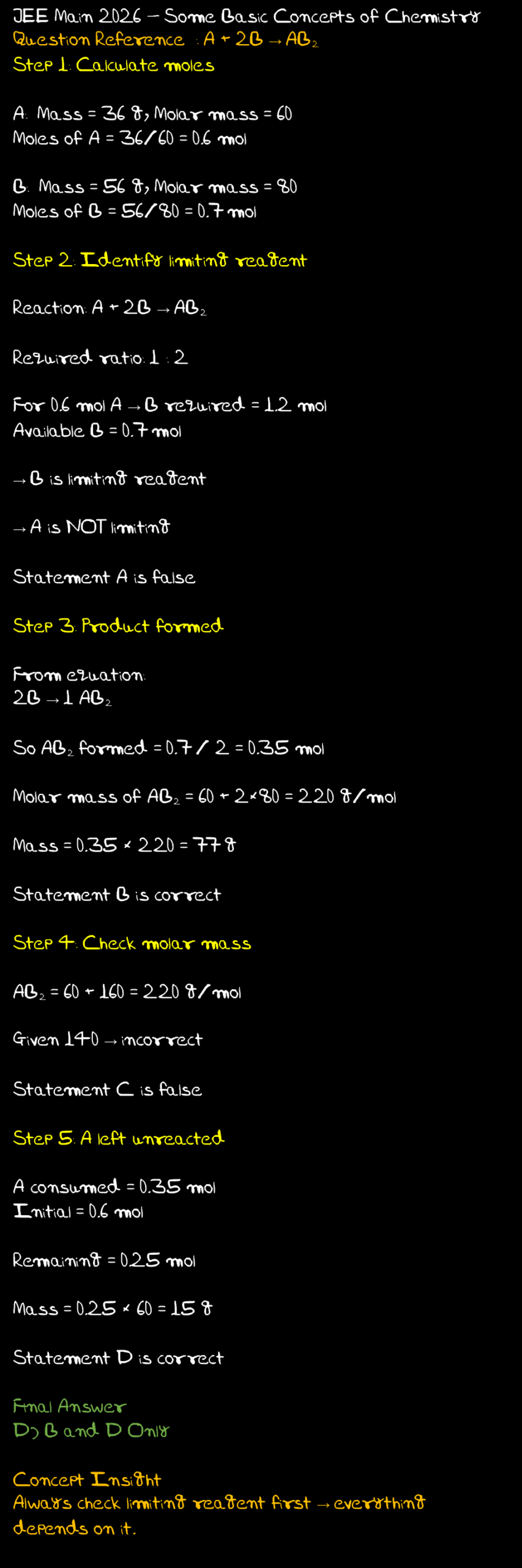
- 2 mol of B produce 1 mol of AB2
- So 0.7 mol of B will produce 0.7/2 = 0.35 mol of AB2
Now calculate molar mass of AB2:
- Molar mass = 60 + 2×80 = 220 g mol−1
Mass of AB2 formed:
- 0.35 × 220 = 77.0 g
So statement B is true and statement C is false.
Step 4: Calculate Unreacted A
- 2 mol of B react with 1 mol of A
- So 0.7 mol of B reacts with 0.35 mol of A
- Initial A = 0.6 mol
- Unreacted A = 0.6 – 0.35 = 0.25 mol
Mass of unreacted A:
- 0.25 × 60 = 15.0 g
So statement D is true.
Step 5: Write Final Answer
- Correct statements are B and D
So the correct option is (D).
Final Answer
Option (D): B and D Only ✓
The correct statements are B and D Only.
Essential Formulas for This Topic
Primary Rules
- Mole Formula:
- Number of moles = Given mass / Molar mass
- This is always the first step in stoichiometry questions
- Limiting Reagent Rule:
- Compare moles divided by stoichiometric coefficient
- The smaller value corresponds to the limiting reagent
- Mass of Product Rule:
- Mass of product = moles of product × molar mass of product
- The limiting reagent controls the final amount formed
Important Notes
- Limiting reagent gets consumed completely
- Excess reagent remains unreacted after completion
- Molar mass of AB2 must be calculated carefully from its formula
- In this question, B is limiting and A is in excess
Common Mistakes to Avoid
❌ Mistake 1: Comparing Given Masses Directly
Wrong Thinking: “Since 56 g is more than 36 g, B cannot be limiting.”
Correct Approach: Always convert mass into moles before deciding the limiting reagent.
❌ Mistake 2: Using Wrong Stoichiometric Ratio
Wrong Thinking: “A and B react in 1:1 ratio.”
Correct Approach: The balanced equation shows 1 mole of A reacts with 2 moles of B.
❌ Mistake 3: Calculating Wrong Molar Mass of AB2
Wrong Thinking: “Molar mass of AB2 is 60 + 80 = 140.”
Correct Approach: AB2 contains one A and two B atoms, so molar mass = 60 + 2×80 = 220 g mol−1.
❌ Mistake 4: Forgetting to Find Leftover Reactant
Wrong Thinking: “Once product mass is found, the question is over.”
Correct Approach: In statement-based questions, always check unreacted excess reagent too.
Key Concept Summary
- Convert mass to moles first: Stoichiometry starts from moles, not grams.
- B is the limiting reagent: Available B is less than required stoichiometric amount.
- 77 g of AB2 is formed: Product mass is controlled by limiting reagent.
- 15 g of A is left: A is the excess reagent.
- Molar mass of AB2 is 220 g mol−1: Not 140 g mol−1.
The Golden Rule for Limiting Reagent Questions
“Convert to moles, compare stoichiometric requirement, then calculate product and leftover reactant.”
Frequently Asked Questions
Q1: Why is B the limiting reagent?
A: Because according to the reaction, 0.6 mol of A needs 1.2 mol of B, but only 0.7 mol of B is available.
Q2: How much AB2 is formed?
A: 0.35 mol of AB2 is formed, which corresponds to 77.0 g.
Q3: Why is the molar mass of AB2 equal to 220 g mol−1?
A: Because molar mass = 60 + 2×80 = 220 g mol−1.
Q4: How much A remains unreacted?
A: 15.0 g of A remains after the reaction is complete.
Q5: What is the correct option?
A: Option (D), B and D Only.
Prerequisites to Solve This Question
- Mole concept: Conversion of mass into moles
- Balanced equations: Reading stoichiometric coefficients correctly
- Limiting reagent: Identifying the reactant consumed first
- Product calculation: Using mole ratio to find product formed
- Excess reagent calculation: Finding leftover reactant after completion
After Solving This, You Can:
✅ Identify limiting reagent confidently
✅ Calculate mass of product correctly
✅ Find excess reagent left after reaction
✅ Avoid common mole concept mistakes
✅ Solve JEE Main stoichiometry questions faster
Study Tips for This Topic
For JEE Main:
- Always convert to moles first: Never compare masses directly
- Watch the coefficient carefully: Many mistakes happen by ignoring stoichiometric numbers
- Check all statements one by one: Statement-based MCQs need full verification
- Revise product mass and leftover mass together: JEE often mixes both in the same question
Common JEE Variants:
- Limiting reagent identification
- Mass of product formed
- Amount of excess reagent left
- Statement-based stoichiometry questions
Related Questions
- Mole Concept Limiting Reagent PYQ Questions
- Stoichiometry Questions for JEE Main
- More Mole Concept Questions
Difficulty Rating & Exam Frequency
Difficulty Level: ⭐⭐⭐ (3/5) – Medium
JEE Main Frequency: High – Limiting reagent and stoichiometry are very common Mole Concept topics
JEE Advanced Frequency: Medium – Often combined with gas laws or reaction mixtures
Topic Importance: Very High – Limiting reagent is one of the core applications of mole concept
Written by Nishant Kumar Gupta
Chemistry Educator with 12+ Years of Experience Teaching JEE Aspirants
Founder – PadhoLikhoJEE
Last Updated: April 2026
Question Source: JEE Main 2026 PYQ
Topic: Mole Concept – Limiting Reagent