
Number of Stereoisomers Possible – Isomerism JEE Main PYQ
Quick Summary
Question Type: Stereoisomerism counting question
Chapter: Isomerism – Optical and Geometrical Isomerism
Difficulty: ⭐⭐ Easy
Time to Solve: 2 minutes
Key Formula: Total stereoisomers = Optical isomers × Geometrical isomers
Correct Answer: (D) 4
Why: The molecule has one chiral center and one C=C double bond showing geometrical isomerism, so total stereoisomers = 2 × 2 = 4.
The Question
JEE Main – Isomerism
The number of stereoisomers possible for the molecule CH₃-CH(OH)-CH=CH-CH₃ is:
(A) 2
(B) 1
(C) 3
(D) 4
Quick Answer
Correct Option: (D) 4
Reasoning: The carbon bearing the -OH group is attached to four different groups, so it is a chiral center and gives 2 optical isomers. The molecule also contains a C=C double bond, which gives 2 geometrical isomers (E and Z). Therefore, total stereoisomers = 2 × 2 = 4.
Video Solution
If you want the full explanation in a clear step-by-step teaching format, watch the video solution below:
Watch Full Video Solution on YouTube
Understanding the Concept
Why This Molecule Shows More Than One Type of Stereoisomerism
Some organic molecules can show both optical isomerism and geometrical isomerism at the same time. In such cases, we count the stereoisomers from each type and multiply them.
Total stereoisomers = Optical isomers × Geometrical isomers
Where:
- Optical isomerism comes from a chiral center
- Geometrical isomerism comes from restricted rotation around a C=C double bond
- If both are present independently, total stereoisomers are multiplied
The Key Principle
To solve such questions:
- Check whether the molecule has a chiral carbon
- Check whether the double bond can show E/Z or cis/trans isomerism
- Multiply the two counts to get total stereoisomers
Detailed Step-by-Step Solution
Step 1: Identify the Chiral Centre
- The second carbon carries the -OH group
- It is attached to four different groups: H, OH, CH₃, and CH=CH-CH₃
- Therefore, this carbon is a chiral center
- So the molecule has 2 optical isomers
Step 2: Check Geometrical Isomerism
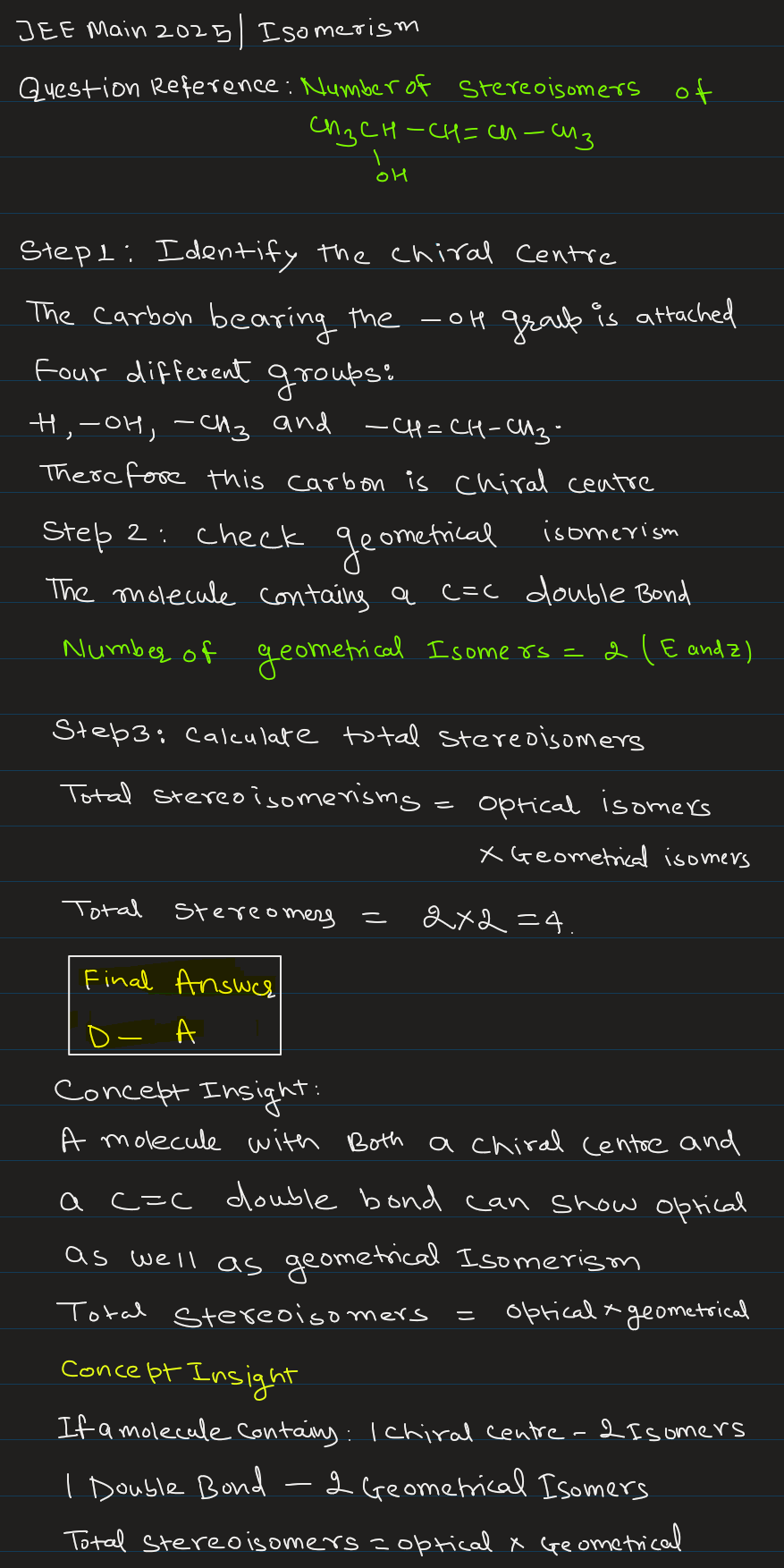
- The molecule contains a C=C double bond
- Each double-bonded carbon has two different groups attached
- So geometrical isomerism is possible
- Number of geometrical isomers = 2 (E and Z)
Step 3: Calculate Total Stereoisomers
Using the standard relation:
- Optical isomers = 2
- Geometrical isomers = 2
- Total stereoisomers = 2 × 2 = 4
Step 4: Final Comparison
Since the molecule shows both types of stereoisomerism:
- It cannot have only 1, 2, or 3 stereoisomers
- The correct total is 4
Final Answer
Option (D): 4 ✓
The molecule CH₃-CH(OH)-CH=CH-CH₃ has one chiral center and one double bond showing geometrical isomerism, so the total number of stereoisomers possible is 4.
Essential Formulas for This Topic
Primary Rules
- Optical Isomerism Rule:
- One chiral center usually gives 2 optical isomers
- Condition: the carbon must be attached to four different groups
- These two forms are non-superimposable mirror images
- Geometrical Isomerism Rule:
- C=C bond can show E/Z isomerism
- Each double-bonded carbon must have two different substituents
- This gives 2 geometrical isomers
- Total Stereoisomer Formula:
- Total stereoisomers = Optical isomers × Geometrical isomers
- Here: 2 × 2 = 4
- This works because both types are independently possible
Important Constants
- A chiral center must have four different groups attached
- A double bond can show geometrical isomerism only if each carbon has two different substituents
- Optical isomers are related as enantiomers
- Geometrical isomers are due to restricted rotation about C=C bond
Common Mistakes to Avoid
❌ Mistake 1: Counting Only the Chiral Centre
Wrong Thinking: “There is one chiral carbon, so the answer must be 2.”
Correct Approach: Also check whether the molecule has geometrical isomerism due to a double bond. Here both types are present.
❌ Mistake 2: Ignoring the Double Bond Condition
Wrong Approach: Not checking whether the C=C bond can actually show E/Z isomerism
Correct Approach: Confirm that both double-bonded carbons have two different groups attached. Only then geometrical isomerism is possible.
❌ Mistake 3: Adding Instead of Multiplying
Common Error:
- Taking 2 optical + 2 geometrical = 4 for the wrong reason
- Not understanding why multiplication is used
Correct Approach: When both independent stereochemical features exist in the same molecule, total stereoisomers are obtained by multiplication.
❌ Mistake 4: Missing One of the Four Different Groups
Wrong Thinking: “The carbon with OH is not chiral.”
Correct Understanding:
- The carbon attached to OH has H, OH, CH₃, and CH=CH-CH₃
- All four groups are different
- So it is definitely a chiral center
- That is why optical isomerism is present
Key Concept Summary
What You Must Remember
- One chiral center gives optical isomerism: Usually 2 optical isomers
- One suitable C=C bond gives geometrical isomerism: Usually 2 geometrical isomers
- Check both independently: Many molecules show more than one type of stereoisomerism
- Multiply the counts: Total stereoisomers = optical × geometrical
- Always inspect the substituents carefully: Small details decide whether isomerism is possible or not
The Golden Rule for Stereoisomer Counting
“If a molecule has both a chiral center and a geometrically active double bond, count both separately and multiply.”
Frequently Asked Questions
Q1: Why does this molecule show optical isomerism?
A: Because the carbon carrying the OH group is attached to four different groups, making it a chiral center.
Q2: Why does this molecule show geometrical isomerism?
A: Because the C=C double bond has two different groups attached on each carbon, so E/Z isomerism is possible.
Q3: Why do we multiply instead of add?
A: Because optical and geometrical isomerism arise independently in the same molecule, so the total combinations are multiplied.
Q4: Can the answer ever be 2 for such a molecule?
A: Only if one of the two types of stereoisomerism is absent. Here both are present, so the answer is 4.
Q5: What is the final number of stereoisomers for CH₃-CH(OH)-CH=CH-CH₃?
A: The final number of stereoisomers is 4.
Prerequisites to Solve This Question
Before attempting this problem, you should understand:
- Chirality basics: How to identify a chiral carbon
- Geometrical isomerism: Conditions for E/Z or cis/trans isomerism
- Stereoisomer counting: When to multiply different types of isomer counts
- Substituent comparison: How to check whether groups are same or different
- Basic organic structure reading: Reading condensed structural formulas correctly
After Solving This, You Can:
✅ Identify chiral centers in organic molecules
✅ Check whether a double bond shows geometrical isomerism
✅ Count total stereoisomers correctly
✅ Solve basic JEE Main isomerism questions faster
✅ Avoid common mistakes in optical and geometrical isomerism
✅ Apply stereochemistry logic to more advanced problems
Study Tips for This Topic
For JEE Main:
- Check chirality first: Look for a carbon with four different groups
- Check the double bond separately: Do not assume geometrical isomerism without verifying substituents
- Use multiplication carefully: Apply it only when different stereochemical features act independently
- Practice small condensed-formula questions: JEE often asks quick-count problems like this
Common JEE Variants:
- Find number of stereoisomers
- Count optical isomers only
- Check whether geometrical isomerism is possible
- Identify chiral carbon in a condensed formula
Difficulty Rating & Exam Frequency
Difficulty Level: ⭐⭐ (2/5) – Easy
JEE Main Frequency: High – Isomerism counting questions are common
JEE Advanced Frequency: Medium – Often asked with deeper stereochemistry logic
Topic Importance: Very High – Fundamental to stereochemistry in organic chemistry
Written by Nishant Kumar
Chemistry Educator with 10+ Years of Experience Teaching JEE Aspirants
Founder – PadhoLikhoJEE
Last Updated: March 2026
Question Source: JEE Main 2025 PYQ
Topic: Isomerism – Optical and Geometrical Isomerism