
Periodic Table Metallic Character Question JEE Main 2026
Quick Summary
Question Type: Metallic character and valence electron comparison
Chapter: Periodic Table – Periodic Trends
Difficulty: ⭐⭐ Easy
Time to Solve: 2-3 minutes
Key Formula: Metallic character increases down a group and decreases across a period
Correct Answer: (C) 5 and 7
Why: Among the given elements, phosphorus (P) has the most metallic character and fluorine (F) has the least metallic character. Their valence electrons are 5 and 7 respectively.
The Question
JEE Main 2026 – Periodic Table
Consider the elements N, P, O, S, Cl and F. The number of valence electrons present in the elements with most and least metallic character from the above list is respectively.
(A) 7 and 5
(B) 6 and 7
(C) 5 and 7
(D) 5 and 6
Quick Answer
Correct Option: (C) 5 and 7
Reasoning: Metallic character increases down a group and decreases from left to right across a period.
- Among the given elements, P is the most metallic
- F is the least metallic
- P belongs to group 15, so it has 5 valence electrons
- F belongs to group 17, so it has 7 valence electrons
Therefore, the required answer is 5 and 7.
Video Solution
If you want the full explanation in a clear step-by-step teaching format, watch the video solution below:
Watch Full Video Solution on YouTube
Understanding the Concept
How Metallic Character Changes in the Periodic Table
Metallic character is the tendency of an atom to lose electrons. Elements become more metallic as we move down a group and less metallic as we move from left to right across a period.
Metallic character increases down a group and decreases across a period
So to solve this question, we compare the positions of the given elements in the periodic table.
The Key Principle
- Find the most metallic element among the list
- Find the least metallic element among the list
- Write their valence electrons using group numbers
Detailed Step-by-Step Solution
Step 1: Write the Elements with Their Positions
- N and P belong to group 15
- O and S belong to group 16
- F and Cl belong to group 17
Step 2: Compare Metallic Character
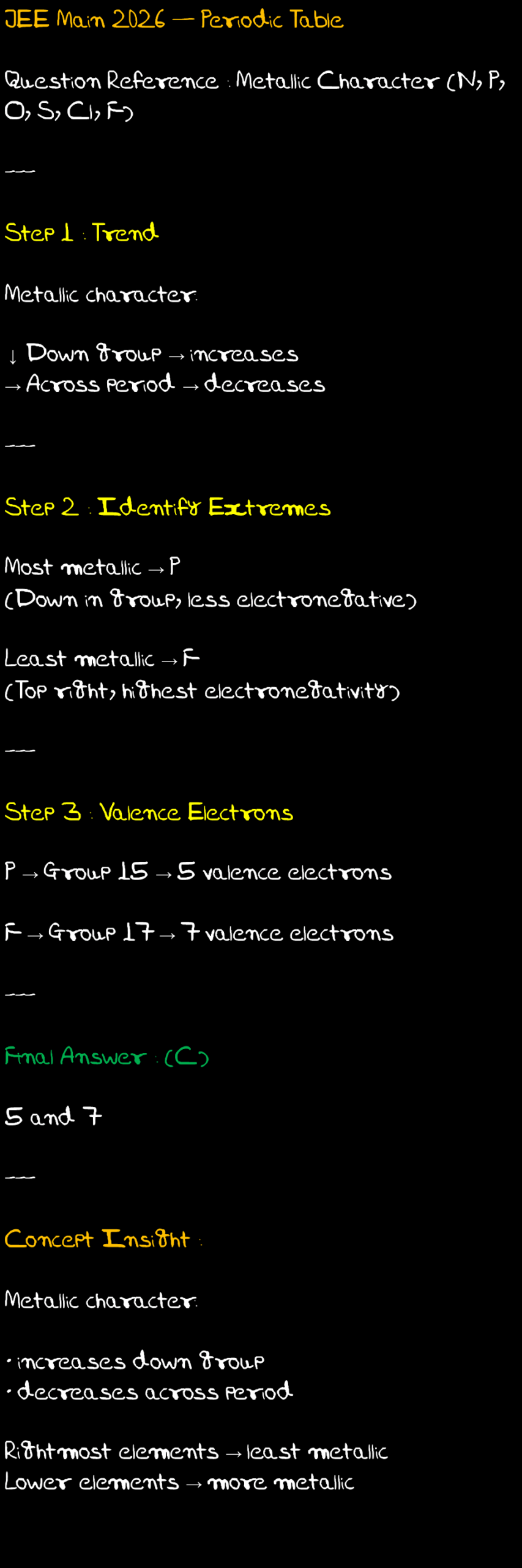
- Within a group, metallic character increases downwards
- So P is more metallic than N, S is more metallic than O, and Cl is more metallic than F
- Across the given set, P is the most metallic
- F is the least metallic because it is the most non-metallic element in the list
Step 3: Count Valence Electrons
- P is in group 15, so it has 5 valence electrons
- F is in group 17, so it has 7 valence electrons
Step 4: Write the Final Pair
- Most metallic element → P → 5 valence electrons
- Least metallic element → F → 7 valence electrons
So the answer is 5 and 7.
Final Answer
Option (C): 5 and 7 ✓
The element with the most metallic character is P and the one with the least metallic character is F. Their valence electrons are 5 and 7 respectively.
Essential Formulas for This Topic
Primary Rules
- Metallic Character Trend:
- Increases down a group
- Decreases across a period from left to right
- Higher tendency to lose electrons means higher metallic character
- Valence Electron Rule:
- Group 15 elements have 5 valence electrons
- Group 16 elements have 6 valence electrons
- Group 17 elements have 7 valence electrons
- Position-Based Comparison:
- P is more metallic than N
- S is more metallic than O
- Cl is more metallic than F
Important Constants
- Fluorine is the most electronegative element
- Higher electronegativity generally means lower metallic character
- Phosphorus is more metallic than the other listed non-metals here
- Group number gives valence electron count for main-group elements
Common Mistakes to Avoid
❌ Mistake 1: Confusing Metallic Character with Atomic Size Alone
Wrong Thinking: “Largest atom must always be the most metallic without checking periodic position.”
Correct Approach: Use periodic trends properly. Metallic character depends on ease of losing electrons and periodic position.
❌ Mistake 2: Picking Chlorine as the Least Metallic
Wrong Approach: Ignoring that fluorine is more non-metallic than chlorine
Correct Approach: Fluorine is the least metallic in the given set because it has the highest non-metallic character.
❌ Mistake 3: Forgetting Group-Valence Relation
Common Error:
- Assigning wrong valence electrons to P or F
- Confusing group 15 with 6 electrons
Correct Approach: Group 15 gives 5 valence electrons and group 17 gives 7 valence electrons.
❌ Mistake 4: Comparing Only Within the Same Group
Wrong Thinking: “Only N and P should be compared with each other.”
Correct Understanding:
- You must compare all six elements together
- The question asks for the most and least metallic from the full list
- P is the most metallic overall
- F is the least metallic overall
Key Concept Summary
What You Must Remember
- Metallic character increases down a group: Atoms lose electrons more easily
- Metallic character decreases across a period: Non-metallic character increases
- P is the most metallic in the list: It is below N and relatively less non-metallic
- F is the least metallic in the list: It is the most non-metallic element given
- Valence electrons come from group number: P has 5, F has 7
The Golden Rule for Metallic Character Questions
“Use periodic position first, then use group number to find valence electrons.”
Frequently Asked Questions
Q1: Why is phosphorus more metallic than nitrogen?
A: Because metallic character increases down a group, and phosphorus lies below nitrogen in group 15.
Q2: Why is fluorine the least metallic in the given list?
A: Fluorine is the most electronegative and most non-metallic element among the given elements.
Q3: How many valence electrons does phosphorus have?
A: Phosphorus belongs to group 15, so it has 5 valence electrons.
Q4: How many valence electrons does fluorine have?
A: Fluorine belongs to group 17, so it has 7 valence electrons.
Q5: What is the final answer to this question?
A: The correct pair is 5 and 7.
Prerequisites to Solve This Question
Before attempting this problem, you should understand:
- Periodic trends: Metallic and non-metallic character
- Group positions: Group 15, 16 and 17 elements
- Valence electrons: Main-group relation with group number
- Basic periodic table reading: Up-down and left-right trends
- Electronegativity idea: Relation with non-metallic behavior
After Solving This, You Can:
✅ Compare metallic character of elements confidently
✅ Use periodic trends in JEE Main questions
✅ Identify valence electrons from group number
✅ Solve quick conceptual periodic table MCQs faster
✅ Avoid confusion between metallic and non-metallic trends
✅ Apply the same logic to other group-based comparisons
Study Tips for This Topic
For JEE Main:
- Memorize periodic trends: Especially metallic, atomic size, electronegativity, and ionization enthalpy
- Use group number quickly: It helps in valence electron questions
- Practice comparison MCQs: They are common and scoring
- Think comparatively, not separately: Always compare the full set of elements given
Common JEE Variants:
- Most metallic or least metallic element
- Highest or lowest electronegativity
- Valence electron comparison
- Periodic trend based match or order questions
Difficulty Rating & Exam Frequency
Difficulty Level: ⭐⭐ (2/5) – Easy
JEE Main Frequency: High – Periodic trend concept questions are common
JEE Advanced Frequency: Medium – Often asked in combined trend-based reasoning questions
Topic Importance: Very High – Periodic Table trends are fundamental in chemistry
Written by Nishant Kumar
Chemistry Educator with 10+ Years of Experience Teaching JEE Aspirants
Founder – PadhoLikhoJEE
Last Updated: March 2026
Question Source: JEE Main 2026 PYQ
Topic: Periodic Table – Periodic Trends